Waikato Management School Pro Vice-Chancellor Jennifer Kerr shares key insights and reflects on standout conversations from the 2026 New Zealand Economics Forum.
When we chose the theme Big choices for a small nation for the 2026 New Zealand Economics Forum, it felt timely.
After two days of discussion at The Pā, it feels urgent.
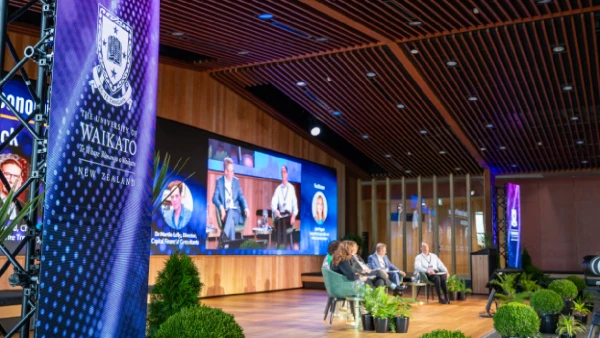
With a sell-out crowd in the room and thousands more joining online, what struck me most was not just the calibre of the speakers, but the depth of engagement. The choices ahead for Aotearoa are not abstract. They are fiscal, demographic, technological and geopolitical, and tightly connected.
In a small country, nothing sits in isolation for long.
I’ve found myself reflecting on several conversations from those two days.
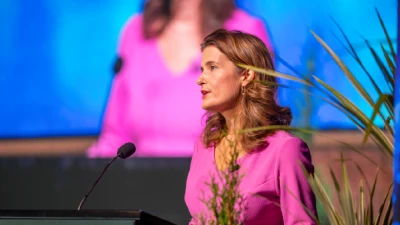
Minister of Finance Hon Nicola Willis
The Forum opened with Hon Nicola Willis, Minister of Finance, outlining the Government’s focus on fiscal discipline and stability in a volatile global environment. Later, Labour finance spokesperson Hon Barbara Edmonds offered a different emphasis, pointing to under-investment, productivity challenges and the urgency of backing local industry.
The contrast was clear, as it should be in an election year. But beyond political philosophy, one theme emerged: in constrained times, delivery matters.
That sense of pressure surfaced again in our session on the demographic tipping point. Distinguished Professor Emeritus Paul Spoonley of Massey University, Professor Tahu Kukutai of the University of Waikato, and economist Isabelle Sin from the Ministry for Regulation challenged us to take the long view. An ageing population. Declining fertility. Migration patterns heavily concentrated in Auckland. These are not abstract trends. They shape housing, infrastructure, labour markets and the fiscal base that underpins our public services.
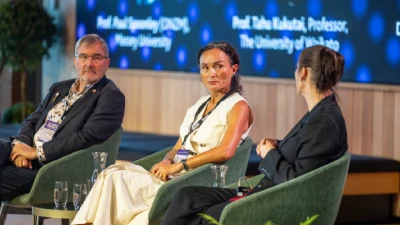
Massey University Professor Emeritus Paul Spoonley and University of Waikato Professor Tahu Kukutai
The challenge of funding New Zealand’s ageing population is becoming increasingly urgent, and those questions were tackled head-on in our Superannuation and the Silver Tsunami session. Blair Turnbull, CEO of Milford, laid out the trajectory clearly. In 1970, seven workers supported every retiree. Today, it is four. In future decades, it may be as few as two.
He was joined by Tracey Martin of the Aged Care Association, former Cabinet Minister David Parker, and ANZ Chief Economist Sharon Zollner. Together they explored what that shift means for superannuation, health costs and intergenerational fairness.
When you look at those numbers, it’s hard not to pause. The debate about superannuation becomes less theoretical and more generational.
Technology added another layer.
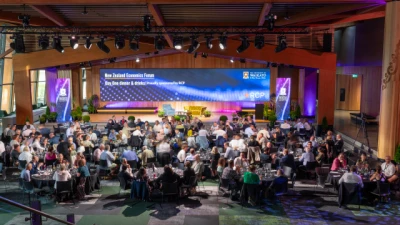
Day one dinner and drinks
Our Mental Health and Social Media session sparked some of the most animated exchanges of the Forum. Anna Curzon, Co-Chair of B416, spoke about the growth in harm since smartphones became ubiquitous. Waikato Professor of ethics, Nick Agar argued that meaningful regulation may be required to shift platform behaviour. Others challenged whether the evidence is as clear-cut as some suggest.
What was clear is that technology now shapes behaviour, productivity and wellbeing. For a small economy looking to lift performance, the question is how to engage with AI and digital platforms in ways that strengthen our social fabric.
The evening dinner brought a different tone. Guests gathered for a fireside conversation with the Speaker of the House, The Right Honourable Gerry Brownlee. Those in the room were treated to candid reflections on public life, leadership under pressure, and the realities behind the headlines. There was humour, honesty and perspective drawn from decades in politics.
It was a reminder that policy is made by people, with all the complexity that entails.
Day two opened with a keynote from Treasury Secretary Iain Rennie CNZM, who framed the discussion in terms of choices that extend beyond the next Budget cycle to the next decade. He acknowledged that while New Zealand is beginning to emerge from a period of economic strain, the global environment is becoming more volatile and fragmented. His message was clear: small nations cannot assume stability, and fiscal resilience matters.
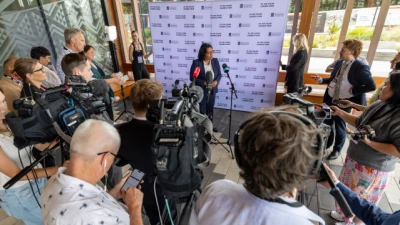
Labour MP Barbara Edmonds
With population ageing already lifting spending pressures, and repeated shocks testing the Crown balance sheet, he argued for rebuilding buffers while also lifting productivity through capital investment and innovation, creating the kind of frontier firms that generate opportunity and give our best and brightest reasons to stay.
From there, the connection between economics and lived experience was brought into sharp focus during The Business of Meth. Dr Jarrod Gilbert presented confronting data on the surge in methamphetamine consumption. Dr Hinemoa Elder reminded us that the estimated $2 billion annual cost touches families and communities across the country, while Northland MP Grant McCallum spoke to the real impact being felt in regional New Zealand.
The Forum closed with Trade versus Security. Major General John Howard, Rosemary Banks, New Zealand’s former Ambassador to the United States, and former Trade Minister Tim Groser examined the tension between prosperity and principle in an increasingly complex geopolitical environment. For a small nation, resilience requires diversification, realism and a willingness to confront uncomfortable trade-offs.
Across the two days, what I will remember most is the energy in the room.
The buzz during the breaks as conversations spilled into the foyer. Debates picking up where the panel left off. New connections forming around shared questions. People leaning in, not tuning out.
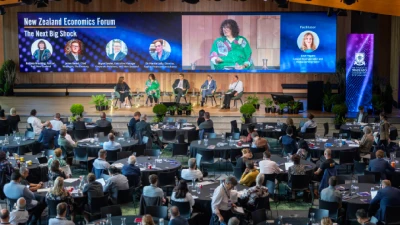 That kind of engagement cannot be manufactured. It reflects a genuine appetite to wrestle with complexity rather than reach for easy answers.
If there was a common thread across the Forum, it was this: small nations do not get to drift.
We do not have the luxury of ignoring demographic change.
We cannot assume global markets will remain stable.
We cannot treat technology as separate from culture and people.
We cannot separate economic resilience from social cohesion.
The strength of this year’s Forum was not that it produced consensus. It was that it brought the trade-offs into the open.
Thank you to our speakers for their candour, our sponsors for their support, and everyone who joined us in person and online. The fact that the Forum continues to grow, in both reach and depth, signals something important.
New Zealanders want serious conversations about the future.
The question now is whether we translate those conversations into deliberate action.
For a small nation, that may be the biggest choice of all.
Catch up on all the 2026 sessions with our 2026 NZ Economics Forum playlist (opens in a new tab)
The 2027 NZ Economics Forum will take place on 11-12 February 2027. Register your interest today (opens in a new tab)