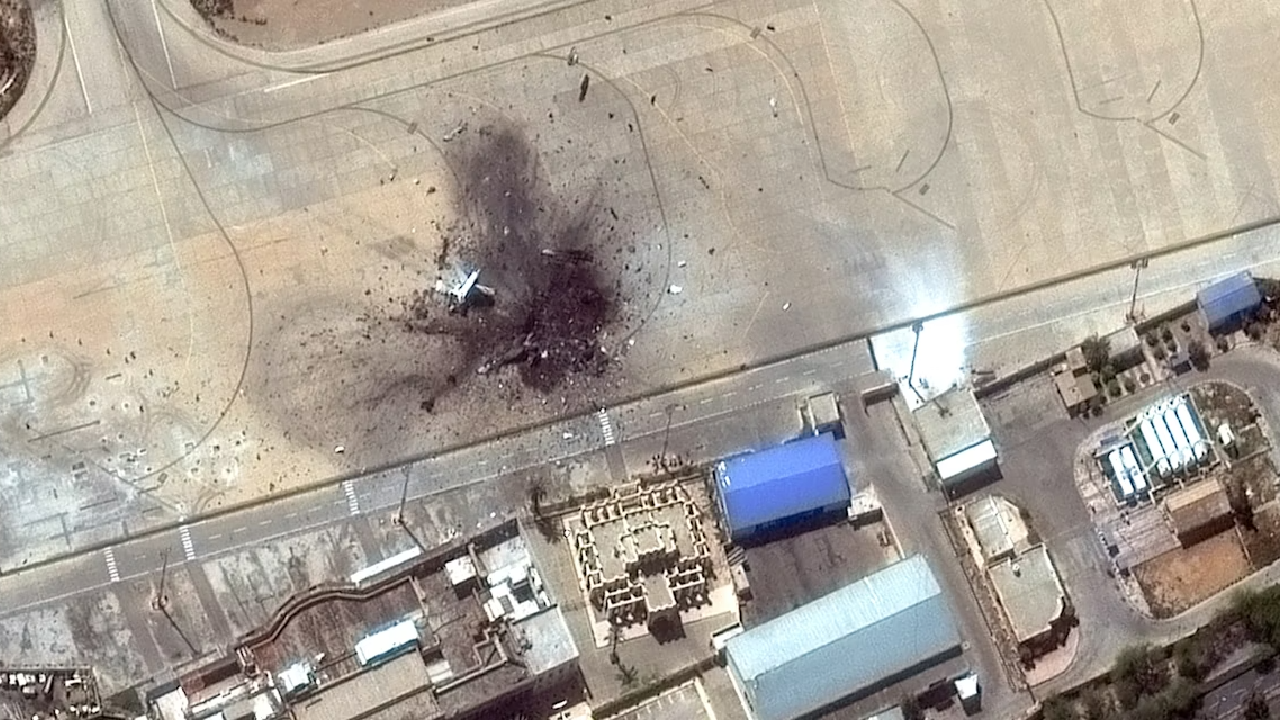
When the United States and Israel launched Operation Epic Fury against Iran nearly two weeks ago, the first confirmation didn’t come from governments. It came from commercial satellites.
Images from US companies Planet Labs and Vantor captured smoke billowing over central Tehran and ships burning at the coastal city of Konarak – evidence of strikes on naval bases, airfields and missile sites that global media confirmed within hours.
But space-based technology was not just observing the conflict, it was also a target. US officials said early strikes hit “Iran’s equivalent of Space Command”, undermining Tehran’s ability to coordinate via satellite.
Iran has also used extensive “spoofing” to create false GPS signals to mislead receivers about their true location.
Simultaneously, US Space Command and Cyber Command launched operations to jam, hack and disrupt Iranian software systems, known as “non-kinetic” attacks in the jargon of modern warfare.
Such operations are a kind of “silent sabotage”, disabling communications or corrupting GPS signals without blowing anything up with conventional “kinetic” attacks.
This combination of advanced battlefield tactics and the rapid commercialisation of space technology, as well as the erosion of the old rules-based order in general, means international law is now falling well behind.
Blurred lines of accountability
Non-kinetic tactics have quickly spilled into civilian life. In January, amid anti-government protests, and later during the first wave of strikes, Iran used GPS jamming and spoofing to disrupt Starlink terminals, which civilians and protesters depended on to stay online and share information during internet blackouts.
At the same time, commercial satellite imagery became part of the conflict itself. After Planet Lab’s images revealed Iranian retaliatory strikes on US and US-linked sites in the Persian Gulf, the company delayed releasing new imagery to avoid aiding real‑time damage assessment by Iranian forces.
On March 10, Planet Labs extended the delay time to two weeks for non-government users, but the US military still receives immediate access.
Modern warfare depends heavily on these kinds of commercial, dual-use space systems. The same satellites that time financial transactions, support hospitals and manage global logistics also guide military operations.
This blurs the traditional legal boundary between civilian and military objects and activities. The International Committee of the Red Cross has warned repeatedly that interference with satellites can harm civilians by disrupting power grids, navigation, emergency services and humanitarian operations.
Outer space is not a legal vacuum. The United Nations’ Outer Space Treaty, the UN Charter itself, and international humanitarian law all apply to warfare in orbit. But the Iran war shows how real‑world practice is advancing faster than these legal frameworks.
A proper treaty is unlikely
Dual-use satellites providing both civilian broadband and military communications also complicate decisions about what constitutes a lawful target.
Legal experts say satellites providing essential civilian services should be presumed to be non-military unless direct military use is demonstrated. But this precept is tested daily over Iran.
Another challenge is political neutrality. If a private company based in a neutral state provides data that can assist military operations elsewhere, the neutral state may face serious questions and diplomatic pressure from other governments about whether it should be held responsible.
The law has not caught up with these commercial realities. Planet Lab’s imagery delays show how companies are having to improvise policy themselves during armed conflict.
And because cyber-attacks can disable military systems without causing physical destruction, they can fall short of “armed attack” thresholds under international law. States can exploit this legal grey zone to gain strategic advantage.
New legal norms may eventually evolve out of the behaviour of governments and commercial operators rather than through formal agreements and treaties. Indeed, geopolitical tensions make a new treaty on military space operations highly unlikely.
This leaves companies, regulators and militaries to define the boundaries of acceptable conduct through their real‑time responses. The result is a battlefield where satellites shape strategy faster than lawmakers can respond.
Anna Marie Brennan, Senior Lecturer in Law, University of Waikato
This article is republished from The Conversation under a Creative Commons license. Read the original article.