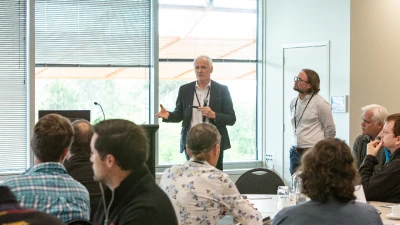
Proposal Director and University of Waikato Professor Geoffrey Holmes speaks to a group of industry leaders and researchers during a two-day workshop in Wellington this month. Photo credit: Mel Waite Photography
Two universities have teamed up to lead a new wave of innovation that could transform outdoor work and help drive New Zealand’s economy using artificial intelligence-powered systems.
The University of Waikato and Te Whare Wānanga o Waitaha | University of Canterbury (UC) were shortlisted in late 2025 to develop a proposal for a $70 million NZIAT-funded national AI research platform. It is aimed at accelerating the translation of AI research into real-world applications, lifting productivity and capability across key sectors, and supporting the growth of globally competitive, high-value industries in New Zealand.
The universities’ proposal – ‘Outdoor AI’ – focuses on developing both physical and digital AI systems designed to operate in complex, real-world environments with initial applications across agriculture, horticulture, aquaculture and other primary sectors, along with the potential to deliver cross-sector impact.
Proposal director and University of Waikato Professor Geoffrey Holmes says New Zealand needs outdoor AI systems designed specifically for the realities of New Zealand’s complex, real-world environments – positioning the country to leverage its unique strengths and lead globally in this space.
He says this advantage is already evident in New Zealand’s primary sectors.

Josh Barnett of 29 Threads discussing the proposal with University of Canterbury Professor Vik Naidoo. Photo credit: Mel Waite Photography
“New Zealand offers a unique environment to develop and test new technologies in real-world agricultural settings. Our farms and orchards operate in challenging environments, which has spurred many innovations in the sector,” Professor Holmes says.
The growing digitisation of farms creates opportunities to improve productivity through data-driven decision making. By combining sensors, software, and robotics, growers can transform their businesses.
Professor Holmes says the broad goal is to establish a centre of gravity in outdoor AI in New Zealand, one that is recognised around the world for leading innovation and technology development.
“As owners of significant whenua and natural resources, we have a strong interest in how technologies like AI are developed and applied,” says Professor Te Maire Tau, Pou Whakarae, Ngāi Tahu Research Centre, University of Canterbury.
“There is a clear opportunity to combine engineering, AI and advanced technologies to both protect our environment and enhance primary production – supporting better long-term decision-making and creating enduring value for future generations.”

Brendan O’Connell of AgriTech NZ discusses the proposal with Professor Angus McIntosh of the University of Canterbury. Photo credit: Mel Waite Photography
Building on this, collaboration with iwi, particularly Ngāi Tahu and Waikato-Tainui, will be central to the Institute. This recognises their significant landholdings, strategic interests in innovation, commitment to intergenerational stewardship, and the importance of mātauranga Māori.
Unlocking the next wave of productivity growth in New Zealand will depend on translating AI research into real-world applications. However, deploying AI in complex, outdoor environments remains a significant challenge. The platform is focused on overcoming this barrier, enabling industry to realise the full value of AI.
The Outdoor AI Research Platform will initially focus on horticulture and agriculture, where New Zealand’s diverse climates and farming systems provide ideal testing conditions.
New Zealand already has a strong track record of technology companies that began by serving outdoor industries, including Halter, Tait Communications, Gallagher Group and Robotics Plus (now part of Yamaha Agriculture). The platform aims to solve industry challenges and unlock new opportunities, enabling existing companies to grow while also supporting the development of new technology ventures.
University of Waikato Deputy Vice Chancellor Research Professor Gary Wilson says the initiative comes at a critical time for the country.
“New Zealand faces significant economic challenges, and if we want to change the trajectory of our economy we must act now,” Professor Wilson says.
“We need research that helps improve New Zealand’s global prospects. Often we make isolated and data poor decisions in our core primary industries. Advances in AI offer a major opportunity to transform the decision-making process in the paddock or at the vine to lift the export value proposition significantly.”

Muneesh Mundaliar, GM Automation and Operational Technology Fonterra, and Kiri Wallace, Eco-Index and University of Waikato, taking part in panel discussions led by Nicola Peddie, Strategic Partnerships Research Advisor at University or Canterbury. Photo credit: Mel Waite Photography
More than 65 per cent of New Zealand’s exports come from outdoor and land-based industries, compared with between five and 30 per cent in most developed countries. While AI is rapidly transforming work in offices and factories, it has had far less impact on outdoor industries.
“This platform is grounded in strong industry pull, with research shaped directly by real-world challenges and opportunities identified through our engagement with partners,” UC Deputy Vice-Chancellor Research and Innovation Professor Lucy Johnston says.
By combining this demand-led approach with New Zealand’s strengths in outdoor industries, we have a significant opportunity to unlock new markets, accelerate the commercialisation of AI-enabled solutions, and grow globally competitive export businesses.
“We are excited about the potential for this platform to position New Zealand as a leader in outdoor AI and to deliver long-term economic value.”
The University of Waikato/University of Canterbury proposal is one of five selected from 108 submissions to progress to the second round of the Government’s AI Research Platform initiative. Results on the research platform are due in late May 2026.