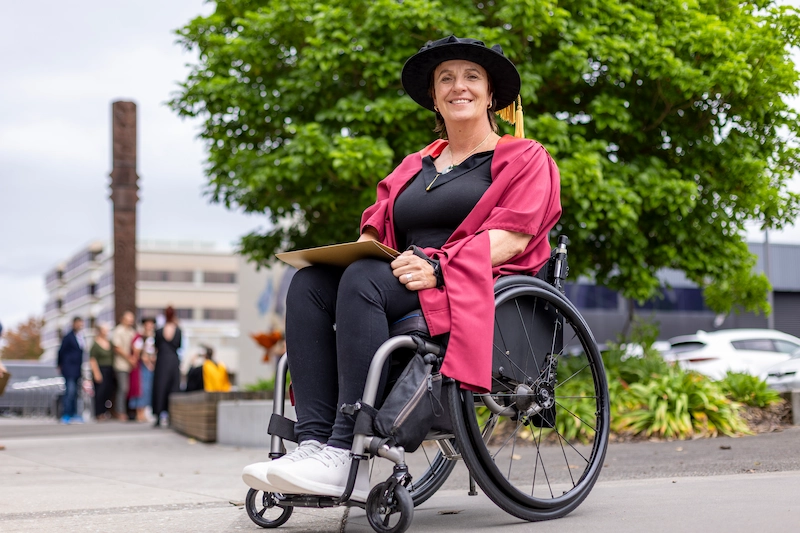
Research from University of Waikato PhD graduate Dr Amanda Lowry draws on her lived experience as a highly impaired, high-performance athlete, to spotlight the critical role of welfare and care for para-athletes in New Zealand.
Dr Lowry was awarded her PhD at the University’s Tauranga campus (opens in a new tab) in April from the School of Human Sport and Movement (opens in a new tab). She says her work “exposes the paradox at the heart of disability sport: a system that celebrates disability visibility, yet so often excludes those with the highest levels of impairment”.
“Athletes with high support needs, whose participation depends on care, interdependence, and time, sit at the very edges of that model - we are in many ways, its antithesis,” she says.
Focusing on care as her thesis subject came from her lived experience with swimming. Her competitive swim times quickly placed her in the top 10 in the world.
“Because there had never been an athlete with my level of impairment swim for New Zealand, the level of care required for me to train and compete was something Paralympics New Zealand hadn’t worked with before - they didn’t know what to do with me.
“It wasn’t until I started to look through the literature, I realised so little was known about the experiences and perspectives of bodies that need bodies - of athletes who actually need and receive care. There has been much research done on and for para-athletes, but very little published by para-athletes, particularly those most marginalised in sport. I realised there was a huge opportunity to tell that story,” she says.
That story - which is the first chapter in her thesis - begins in 2013. At the age of 42, six days after the birth of her second child, Dr Lowry suffered a life-altering injury.
She went from being a “strong, six-packed, kite-surfing wahine” to a tetraplegic.
“My partner had just given birth and come out of hospital, and we had a mate visiting, so I decided to take him to the beach and show him a good time. I was out surfing, and I dove off my board without my hands up above my head, I hit the bottom and I broke my neck.
“You have to write a different story when you experience a life changing injury. But not often do you have an opportunity to live two lives in one life. When I look back, or see photographs of the old me, it's a like the death of a friend. I miss her, but I can’t wish her back. I’m grateful to her for providing the strong foundations on which to build the new me."
Having lived “two lives”, Dr Lowry knew what athletic success could and should feel like, but her experience as a para-athlete was problematic.
"Despite the fact it's sport for disabled people, high-performance disability sport is grounded in able bodied models. Athletes are expected to be autonomous, high functioning and driven and while I’m driven, I'm neither high functioning nor independent."
"A support worker gets me up in the morning, they move me, they stretch me, they take off my pyjamas, put my togs on, they move me to the edge of the bed, and help transfer me to the wheelchair. While I independently drive to the pool, they meet me there and help me transfer onto a hoist and into the water.
“Like other athletes with high support needs, I'm a body that needs a body to participate in everyday life, and that need is intensified with my participation in sport.”
Dr Lowry interviewed 11 high-performance para-athletes, seven organisational representatives and two support workers for her research. Her thesis is an unflinching look at highly impaired para-athletes and the critical role carers play. Her findings introduce the “messy, gritty, embodied experiences” of impairment, crip time, emotional labour and interdependence that shape the daily lives of athletes with high support needs.
“Sporting organisations need to understand athletes with high support needs bodies do not bend to the stopwatch, and support workers are often forced to deliver ‘care on time’ in a system that affords no time for care. If the carers are recognised for the mahi that they do, if organisations are resourced to provide care, it levels the playing field for all of us,” she says.
On 19 May, Dr Lowry will present her research at the International Paralympics Committee (IPC) 2026 VISTA virtual conference as a panellist. She is motivated by the chance to see duty of care genuinely realised in high-performance sport.
“The IPC want to raise the participation of those with higher levels of impairment, and they want to engage with what I’ve got to say.
“My thesis is just the beginning - the start of the conversation. If you build a sporting system grounded on those with the least presence, on their lived reality, the system will be truly inclusive.”