A new agreement will widen access to medical training and bolster the primary care workforce in Canterbury and beyond.
Signed by the University of Waikato (Waikato) and the University of Canterbury (UC) yesterday, the agreement will bring together the complementary strengths of both universities to help grow a highly trained, community-connected medical workforce.
The agreement will strengthen medical education pathways, support regional and rural health services, and create opportunities for collaborative research benefiting communities across New Zealand.
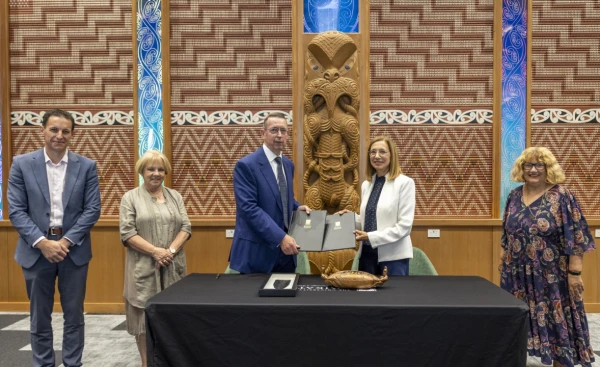
Pro Vice-Chancellor of the Division of Health Professor Jo Lane, Chancellor Susan Hassall and Vice-Chancellor Professor Neil Quigley from the University of Waikato, with Vice-Chancellor Professor Cheryl de la Rey and Executive Dean of the Faculty of Health Dr Cathy Andrew
The agreement signals an intention for Waikato and UC to work together to support pathways for UC graduates to enter the New Zealand Graduate School of Medicine.
Waikato Vice-Chancellor Professor Neil Quigley says he is pleased the NZGSM has created a vehicle for the two universities to work together to reduce barriers for graduates to study medicine in New Zealand.
“We are looking forward to working with the University of Canterbury to create opportunities for graduates from the region to study medicine and undertake clinical placements close to home.”
The intention, he says, is that the graduates will then choose to continue to live and work as doctors in their home region.

Professor Jo Lane and Professor Te Maire Tau
“Though based at the University of Waikato, the New Zealand Graduate School of Medicine is being designed to produce doctors who will serve in regional and rural communities throughout the whole of New Zealand,” he says.
The developing partnership strengthens UC’s commitment to health education by creating clear pathways for future health professionals. UC’s Faculty of Health is also introducing programmes such as the new Bachelor of Health, which can also be studied online, to address workforce needs across the South Island. In addition to the Bachelor of Health, UC offers a wide range of health-related programmes across multiple disciplines, further strengthening UC’s position to support students who may later pursue graduate-entry medical training.
Under the agreement, UC graduates from a wide range of disciplines will have the opportunity to pursue medical training while staying connected to their communities.
UC Vice-Chancellor Professor Cheryl de la Rey says the partnership reflects a shared commitment to creating meaningful opportunities for graduates and supporting the health needs of regional communities.
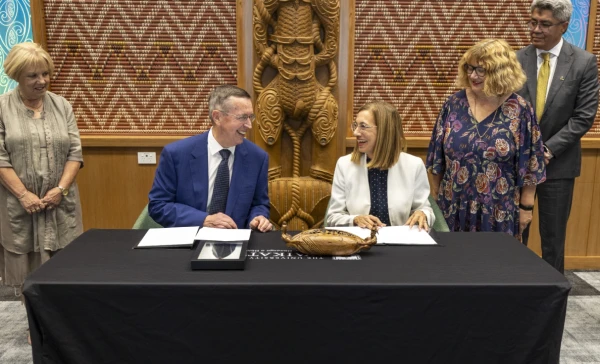
University of Waikato and University of Canterbury representatives at the signing of a new partnership agreement
“We’re delighted to offer University of Canterbury graduates a pathway to pursue medical training through this partnership. At the heart of our approach is a commitment to helping future practitioners stay closely engaged with the communities and regions that shaped them, something that is especially important for the South Island.”
The agreement will see the universities work together on research, including the acquisition of joint research funding and the potential establishment of joint centres of excellence.
The agreement was signed on campus at Waikato, and a pōwhiri and formal ceremony was held at The Pā, bringing the two university teams together in person.
Outlined in an agreement signed with the Ministry of Health in February 2024, the partnership fulfils a Government objective for the new medical school to foster co-operative relationships with other New Zealand universities, reducing financial and locational barriers for qualified graduate students to study medicine.
Approved by the Government in July, the NZGSM will open in 2028. Its four-year graduate-entry programme will see all students study for one year on the Waikato campus in Hamilton before undertaking three years’ worth of clinical placements in regional and rural communities nationwide.
Graduates with a bachelor’s degree in any field of study will be eligible to apply. Applicants will also need to achieve a minimum grade in the Graduate Medical School Admissions Test, which is a standardised medical admissions assessment that considers an applicant’s background knowledge of science, social science, and written communication.
The NZGSM will be New Zealand’s first graduate-entry medical school. They are the most common model of medical education in Australia and are the predominant model of medical education in Canada and the USA.
This approach has proven to be highly successful in targeting areas with specific need, such as primary care shortages.