Vice-Chancellor Professor Neil Quigley says the MoU, signed with the Ministry of Health, is a significant step towards addressing health workforce needs and reducing New Zealand’s heavy reliance on importing doctors from overseas.
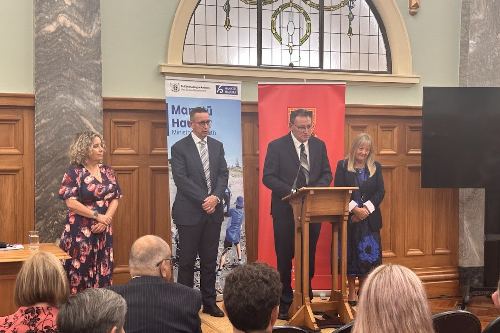
L-R: Director-General of Health Dr Diana Sarfati, Professor Neil Quigley, Minister Shane Reti, Minister Penny Simmonds.
“The University of Waikato has long advocated that an investment in a third medical school is part of the solution to our current and future health workforce needs. It will provide a new model of medical education in New Zealand, with new entry pathways attracting a more diverse range of students. It will be new approach to matching medical education with our actual workforce needs, and a new approach to integrating provincial and rural communities into the medical education programme.”
Professor Quigley says the University will now work with the Government to provide the business case for the medical school.
“We are committed to the medical school and to working with partners in other parts of New Zealand, as well as to building a full range of allied health programmes.”
He says the current situation is not going to materially improve if nothing changes. “We need to train more doctors, we need to select students from a wider range of backgrounds who are committed to long-term careers in primary care outside the main centres and we need to place these students in the regions where they are needed.”
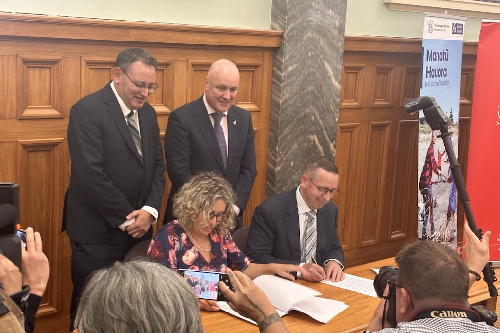
Clockwise: Minister Shane Reti, Prime Minister Christopher Luxon, Professor Neil Quigley, Dr Diana Sarfati.
Professor Quigley says the University of Waikato plans to have an intake of up to 120 medical students each year chosen from students who have already completed an undergraduate degree. The students would receive four years of intensive, practical medical education. This graduate-entry model is used by many of the world’s highest ranked medical schools and is the dominant model of medical education in Australia.
The University of Waikato has been building its capability in health and is proud of the success of its newly-established nursing programme, with the student intake increasing from 40 in 2021 to more than 210 in 2023, in response to severe staff shortages in both the region’s and the nation’s health workforce.
The University is also developing programmes for other health professions in direct response to stakeholder needs within the region and the country.
Professor Quigley says the University of Waikato is well placed to deliver a new medical school and it has widespread stakeholder support to do so.
“We look forward to working with the Government on the processes required to facilitate the medical school.”