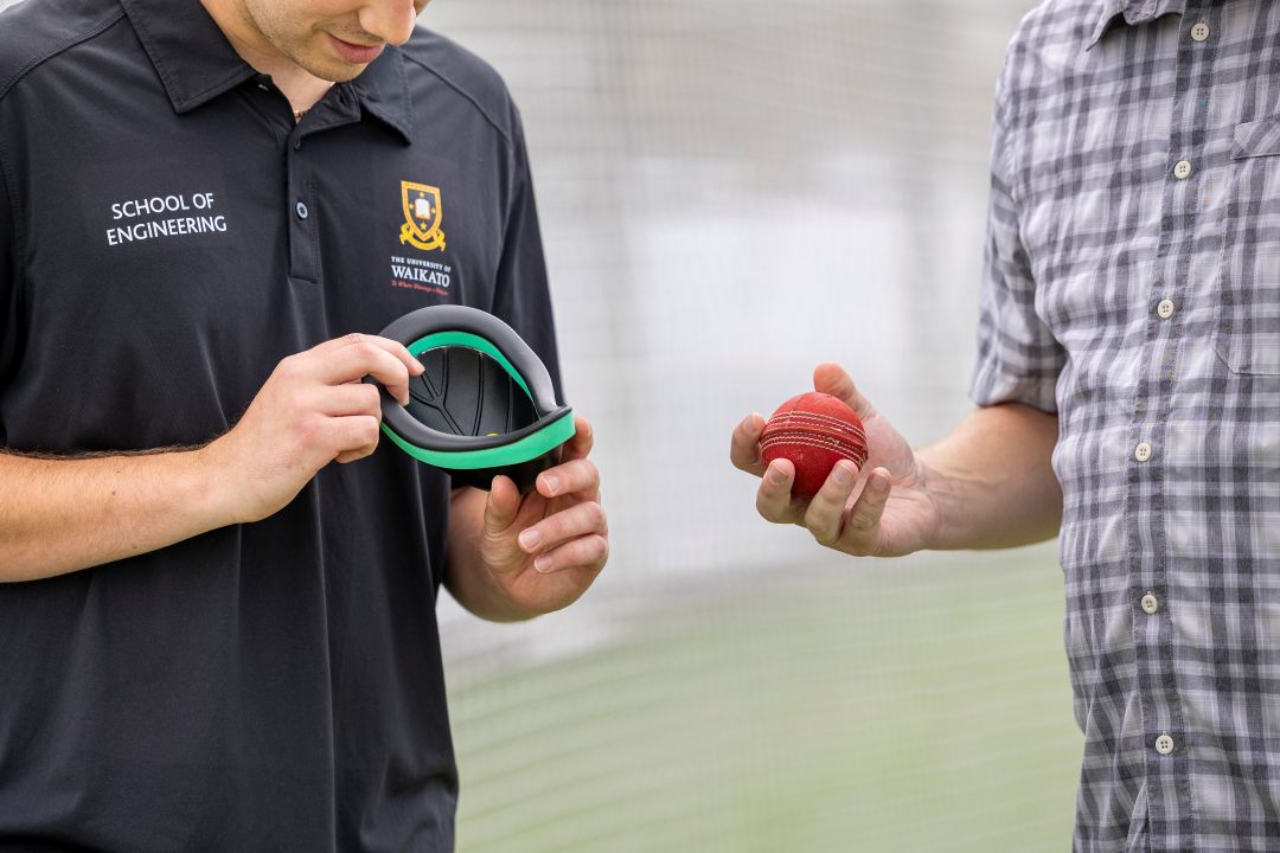
A University of Waikato engineering graduate has played a large part in developing innovative new cricket player protection, aiming to improve safety in one of the sport’s most vulnerable areas.
Dr Keegan Hall, who began developing the technology during his undergraduate engineering degree at Waikato and continued refining it alongside his PhD, played a key role in designing a new cricket box that uses engineered materials and designs based on rigorous testing to better protect players from high-speed impacts.

Dr Keegan Hall
A cricket box is a hard protective guard worn by players to shield the groin from the impact of the cricket ball.
The box is the first product from new sports protection brand Cover, co-founded by Black Cap Kane Williamson, and was sparked in 2012 during a memorable Test match versus South Africa.
Facing the undisputed number one ICC Test bowler of the time, Dale Steyn, Williamson was hit flush in the box, cracking it and causing intense pain.
Fast-forward, Keegan’s involvement in the project began with a summer engineering work placement with Cover co-founder Jason Low and later continued into his engineering R&D capstone, jointly supervised by Mr Low and Dr Tim Walmsley, Associate Professor in Te Kura Mata-Ao School of Engineering.
“It started with the idea there should be something better than the standard plastic protector,” says Keegan.
Keegan spent months researching existing products, testing materials, and building prototypes.
Early experiments included firing cricket balls at protective gear using a bowling machine which he found wasn’t accurate enough, so Keegan custom-built an air cannon capable of replicating high-speed impacts.
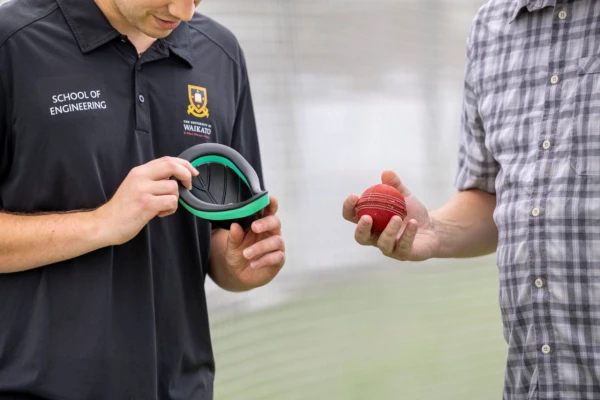
The product is made out of aluminium and foam
“We bought a range of products and tested them. All cracked, split or dented under impact speeds below what is experienced in professional cricket, which showed there was definitely room for improvement,” he says.
Through computer simulations and physical testing, Keegan identified aluminium as the optimal material for the outer shell, balancing strength, weight, and cost.
“The shell prevents direct impact to the body, but the foam does a lot of heavy lifting. It absorbs the force and disperses the load, so the player feels significantly less impact.”
The development took five years from the early prototypes to the finished product which is now available to be purchased.
“It’s pretty surreal to go from those first rough prototypes to now holding a finished product that people are actually using,” Keegan says.
The initial response to the product has been overwhelmingly positive, Keegan acknowledged, while also noting that it highlights the importance of addressing the stigma around groin injuries in cricket.
“It’s something players don’t always talk about, even when injuries are serious. But it’s an area where better protection can make a real difference.”
Keegan says the project demonstrates the value of collaboration between universities and industry, with Waikato providing access to labs, equipment and technical expertise.
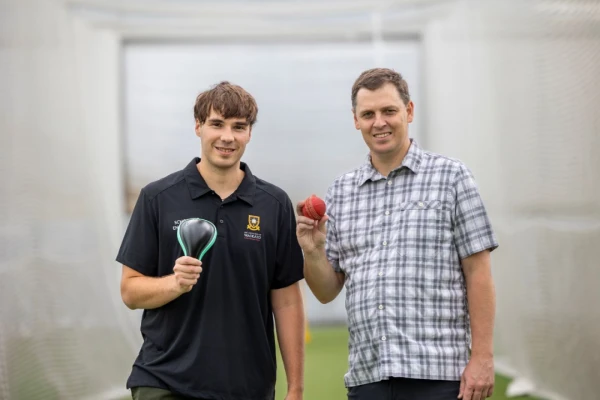
Dr Keegan Hall and Professor Tim Walmsley
“Without the University’s facilities and support we couldn’t have done this. When you’re starting out with a project that partnership is really important.”
Now working as a postdoctoral researcher in energy engineering at Waikato, Keegan remains involved with Cover in an advisory capacity, supporting further product development and testing.
He says the experience has been a unique opportunity to combine engineering with his personal passion.
“Being able to work on something connected to a sport you love is pretty special and hopefully it makes the game safer for everyone playing it.”
Dr Walmsley, who continues to work closely with Keegan noted,
“Waikato Engineering has a strong innovation culture and a decades-long track record of partnering with industry to deliver practical solutions, as demonstrated in Keegan’s story and many others.”