Disaster impacts and system resilience
The University of Waikato has a leading research profile in climate adaptation in New Zealand with multiple projects underway examining how communities, systems and environments can better prepare for and respond to climate-related risks.
Drawing on expertise across sociology, environmental planning, logistics and supply chain, economics and climate science, Waikato researchers are generating evidence-based insights that support more resilient decision-making.
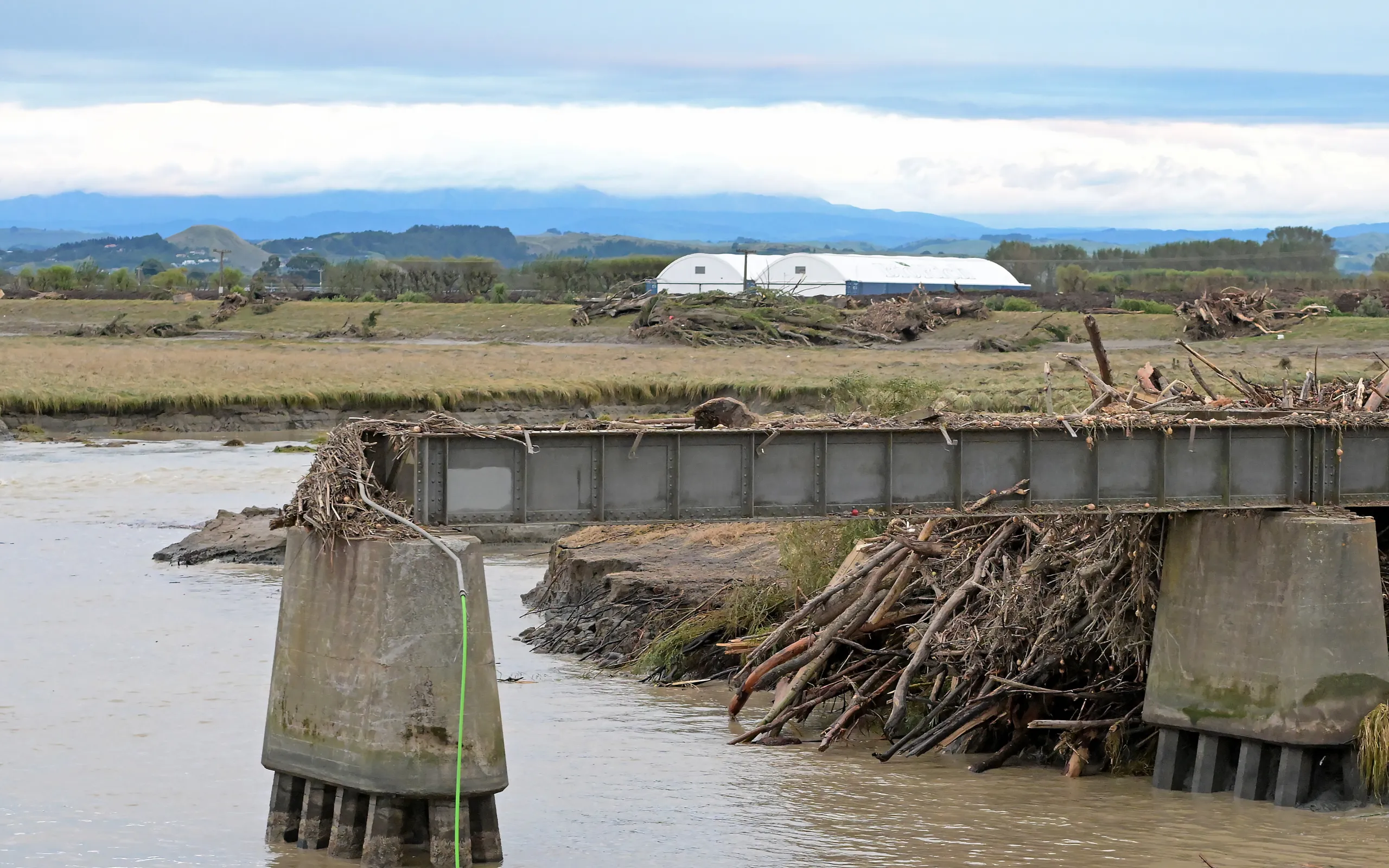
Cyclone Gabrielle in early 2023 caused widespread damage across the North Island of New Zealand, particularly in Gisborne and Hawke’s Bay (opens in a new tab). Homes were destroyed, infrastructure severely damaged, supply chains disrupted, and communities displaced. Beyond the immediate destruction, the event highlighted how disasters trigger cascading impacts across interconnected systems – affecting health systems, transport networks, housing, finance, and community wellbeing.
As climate change accelerates, extreme weather events are becoming more frequent, more intense, and less predictable – challenging planning approaches that rely heavily on historical patterns. Areas once considered low risk are now experiencing significant impacts. Our researchers are contributing to improved flood risk assessments that incorporate future warming scenarios and examine potential impacts on housing, infrastructure and vulnerable populations. Disasters affect more than physical infrastructure. When roads and transport networks fail, freight movement, essential services and economic activity are affected, exposing New Zealand’s reliance on road transport and the lasting social and health impacts that follow.
Our research highlights that recovery decisions are often made on compressed timeframes, under pressure to rebuild quickly and restore normality. However, rebuilding “like for like” in high-risk locations can entrench vulnerability. Repeated rebuilding of damaged infrastructure, ongoing financial strain and cumulative environmental degradation can push regions toward thresholds where recovery becomes increasingly difficult and costly.
While large-scale disasters like Cyclone Gabrielle dominate national attention, our research shows that focusing only on headline events risks overlooking the cumulative effects of smaller, more frequent disasters. All communities face some element of evacuations, insurance pressures, economic disruption, and long-term stress, and our research indicates that disaster resilience must account not only for major events, but also for the steady accumulation of smaller shocks that collectively strain systems over time.
Through strong national and international partnerships with researchers, government agencies and the private sector, we play a key role in translating research into practical guidance, policy inputs and real-world solutions. Our researchers have called for changes to government policy on freight infrastructure after their studies showed the negative impact that small and large disasters on community health and wellbeing, have emphasised the need for improved disaster impact data to inform policy and practice, and advocated for stronger, clearer regulations on environmental risk disclosure.
Our research highlights the need for integrated and forward-looking approaches across all four phases of disaster management (prevention, preparedness, response and recovery), including avoiding development in at-risk areas, building redundancy into infrastructure systems, strengthening legislative and planning frameworks, and embedding long-term resilience into recovery decisions.



2025 Highlights
Cyclone Gabrielle revealed how deeply interconnected New Zealand’s social, economic, environmental and infrastructure systems are in the face of extreme events. Our researchers examined the broader and longer-term consequences of such disasters.
When transport networks fail
New Zealand is heavily reliant on road transport, making the freight system particularly vulnerable during weather-related disasters that disrupt supply chains, causing delays, increased costs, workforce pressures and reduced access to essential goods. Research examining post-disaster freight disruption, including interviews with fresh fruit and vegetable growers, showed that these impacts are rarely caused by a single failure, but instead arise from interconnected breakdowns across infrastructure, policy, operations and decision-making.
Health and wellbeing
Natural hazards like cyclones do not affect everyone equally; some people and communities are much more vulnerable than others. Our researchers conducted interviews with residents, health workers and first responders to understand the health and wellbeing impacts of Cyclone Gabrielle and to identify lessons for future preparedness and response. Our studies showed that physical injuries, disrupted access to healthcare, and long-lasting mental health challenges extended well beyond the immediate emergency period. The research also revealed that older people, those with disabilities, and residents of rural and remote areas faced heightened risks and barriers to support, and strong community networks played a critical role in care, recovery and resilience.
Rethinking disaster planning
Our researchers are reshaping how disaster impacts are understood and incorporated into policy and planning. Analysis of flood events across New Zealand over the past three decades shows that economic and social damage occurs across disasters of all sizes – not only the largest, headline-grabbing events. The research identifies gaps and inconsistencies in how disaster data are collected and highlights an over-reliance on rainfall measurements that do not fully capture community impacts.
Biodiversity as a financial risk
Cyclone Gabrielle reinforced that environmental shocks can quickly translate into economic consequences. Our research highlights that biodiversity loss is not only an environmental issue, but also a financial and systemic risk. Studies show investors respond strongly to biodiversity-related events, with share prices and market volatility shifting when companies are linked to environmental damage or new risk disclosures. As climate-driven disasters increase pressure on ecosystems, integrating biodiversity risk into financial decision-making is critical to strengthening long-term economic resilience.
Citations
Akyildirim, E., & Corbet, S. (2025). Examining the financial impact of biodiversity‐related reputational disasters. Corporate Social Responsibility and Environmental Management. https://doi.org/10.1002/csr.3197 (opens in a new tab)
L’Hermitte, C., Trent, N. M., Qin, Y., & Friday, D. (2025). Capturing the full complexity of post disaster freight disruptions: An application of the theory of constraints. Transportation Research Record: Journal of the Transportation Research Board, 2679(6). https://doi.org/10.1177/03611981251322455 (opens in a new tab)
L’Hermitte, C. (2025). NZ’s over-reliance on roads for freight means natural disasters hit even harder. But there is a fix. The Conversation. https://theconversation.com/nzs-over-reliance-on-roads-for-freight-means-natural-disasters-hit-even-harder-but-there-is-a-fix-253008 (opens in a new tab)
Tennakoon, K. P., Serrao-Neumann, S., & Cretney, R. (2024). Identifying and classifying broader scale of disaster impacts to better inform disaster management policies and practice. Natural Hazards, 121. https://doi.org/10.1007/s11069-024-06707-w (opens in a new tab)
Thorpe, H., Langridge, F., Egli, V., McClutchie, J., Bell, J., Horgan-Heke, E., Caddie, M., McCool, J., & Laking, G. (2025). ‘It affected everybody, but affected people differently’: The health and wellbeing impacts of Cyclone Gabrielle on East Coast communities of Aotearoa New Zealand. Kōtuitui: New Zealand Journal of Social Sciences Online, 20(4), 1271-1291. https://doi.org/10.1080/1177083X.2025.2523344 (opens in a new tab)
Thorpe, H., Langridge, F., Laking, G., & McCool, J. (2024). Lessons from Cyclone Gabrielle: 5 key health priorities for future disaster response. The Conversation. https://theconversation.com/lessons-from-cyclone-gabrielle-5-key-health-priorities-for-future-disaster-response-239392 (opens in a new tab)