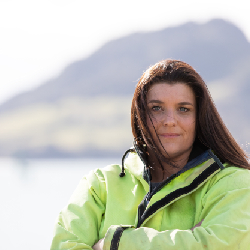

Melissa Kellett
Master of Science (Research)

Qualification(s)
A University of Waikato master’s student who led research on bronze whaler sharks graduated from the University’s Tauranga Campus on Friday, September 2.
Melissa Kellett received her Master of Science (Research) (opens in a new tab) in Biological Sciences degree. She has been investigating the role bronze whalers have within coastal New Zealand waters, and the possible impact if removed from local marine systems.
“I feel a combination of excitement and relief to be graduating. My journey to get here has been a long one,” says the first-class honours student who juggled solo-parenting, part-time work and an eight-year master’s degree.
Melissa grew up in Havelock North and attended Woodford House. She says her obsession with the marine world began after her mum took her to the movies to see Free Willy at age 8.
“From there Christmas presents comprised of books on the ocean and adopted marine animals, and I would label and learn the parts of a fish in the weekend for fun.”
She took up competitive swimming and surf life saving to get closer to the ocean and went out on fishing trips with her dad and his friends.
“This is when I saw my first shark, but also the mistreatment of them. Little did I know this was to become my greatest focus.”
Bronze whalers are typically found in temperate shelf environments; yet little is known about their movements during winter when sightings and interactions within inshore waters cease.
As part of her master’s research, Melissa put satellite tags on a small number of bronze whalers that were caught locally in the Tauranga Harbour, indicating the sharks were travelling further offshore and spending time in oceanic waters in the cooler months.
“Satellite tags hadn’t been used on this species before, so this was the first official documentation of such movements.”
Melissa also sampled different species to indicate foraging behaviour.
“Completing a master’s has definitely taken my ability as an aspiring scientist to the next level.”
Melissa travelled to Hamilton each week to complete the paper component of her degree and says it wouldn’t have been possible without the support and patience from her friends, classmates, daughters and the University.
Throughout her master’s, Melissa tutored for her physiology teacher, Associate Professor Nicholas Ling, and worked alongside him during shark dissections.
“His support has provided me with some amazing opportunities where I was able to discover I also had a love for teaching.”
Melissa was also grateful for the support she received from Professor Chris Battershill (opens in a new tab), an expert in the field of marine science. It was Professor Battershill who initially encouraged Melissa to enroll in postgraduate study.
“As soon as the possibility of shark research was mentioned, I was hooked.”
Melissa hopes to do her PhD in the near future, continuing to build her skills and knowledge, and develop more expertise in the area of shark and fisheries management.
Melissa is working for a locally owned pelagic fishery where she ensures compliance with the Food and Fisheries Acts and manages the sampling programme and supports the resident scientist.
- Biological Sciences was replaced by Ecology and Biodiversity and Molecular and Cellular Biology in 2018.
Qualification(s)