Starting my PhD, I saw an opportunity to combine my background in electrical and electronic engineering with neuroscience research that could one day improve people’s lives.
My research focused on transcranial magnetic stimulation, commonly known as TMS. The technology uses a coil positioned above the head to produce a magnetic field, which can stimulate neurons without touching the person.
TMS is used internationally to treat depression and is also being investigated for other neurological and mental health conditions, including anxiety, Parkinson’s disease and stroke. However, there is still much to learn about how the brain responds to different magnetic pulses and levels of stimulation.
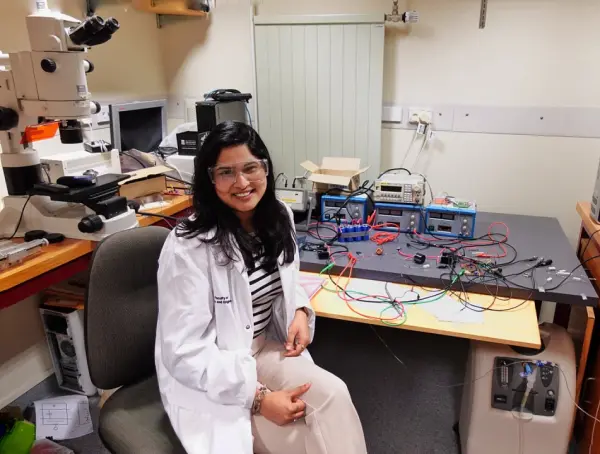
Dr Soniya Raju
My supervisor was already researching how to miniaturise TMS and had developed a coil, but the electronic circuitry needed further work. With my engineering background, this was where I could contribute.
The result was a simpler, more affordable way to generate the high voltage pulses needed for miniaturised TMS. Traditional systems rely on dedicated power supplies, while our design uses supercapacitors to deliver the required energy, reducing the system's complexity.
The system also allows researchers to precisely control the strength, length and shape of each pulse. This is important because different waveforms may affect the brain in different ways, but more research is needed to understand which settings work best for particular areas of the brain.
We successfully tested a proof-of-concept prototype, supported by a new numerical model developed because existing approaches could not accurately predict the circuit’s behaviour.
The model allowed different control signals to be tested and refined before changes were made to the physical system. Its predictions closely matched the experimental results, giving us confidence in the design and its potential to provide researchers with a more flexible, affordable way to study the brain’s response to magnetic stimulation.
The next step was to develop a miniature version of the system that could be used in a controlled laboratory setting.
Working on a smaller scale allowed researchers to study how the technology performed and better understand the effects of different magnetic pulses and levels of stimulation. These findings could provide valuable insights before considering how the technology might eventually be developed for use in humans.
Early testing showed the circuit could produce the required output, including a magnetic field of up to 400 millitesla, although further research would be needed to determine its biological effects.
Neuroscience was completely new territory for me. Before beginning this work, I had never seen this type of laboratory research, and it became one of the most fascinating parts of the project.
I also enjoyed the practical challenge of building the circuit. There was a great deal of trial and error, including plenty of burnt-out capacitors and inductors, but solving those problems was one of the most rewarding parts of my PhD.
What surprised me most was the technology’s potential impact. At first, I viewed it primarily as a piece of equipment to design. As the research progressed, I began to understand what it could mean for people living with mental health conditions or recovering from a stroke.
There is research suggesting that stimulating neurons may assist in recovery following a stroke, but much more work is needed to understand both the potential benefits and risks.
I started the PhD focused mainly on the engineering challenge. By the end, I was thinking much more about where that engineering could lead.
Now working as a lecturer, I would welcome the opportunity to develop the research further. Expanding the system would require specialised equipment and additional funding, but it could help researchers better understand magnetic brain stimulation and, ultimately, how it might be used safely to improve people’s lives.
Originally published in the Sunday Star-Times Brainwaves feature. Read the original on The Post. Brainwaves: Engineering a deeper understanding of the brain