Hunger can affect the accuracy of scent detection work
Dogs trained in scent detection may be better at sniffing out the right smell after breakfast, with new research finding hungry dogs that are working for treats are more likely to falsely identify the wrong scent.
The study, led by researchers from the University of Waikato and Adelaide University (opens in a new tab), explored how meal timing affected dogs’ accuracy in detecting target scents.
Dr Tim Edwards, (opens in a new tab) from the University of Waikato, says the findings suggest hunger may influence how dogs respond to smells when searching for a target.
“What we found is that hunger appears to change the likelihood of a dog saying a target scent is present, rather than simply making them better or worse at smelling,” Dr Edwards says.

University of Waikato Dr Tim Edwards, Associate Professor in the School of Psychology’s Behaviour Analysis Programme, and Director of the University's Scent Detection Research Group
“When dogs hadn’t eaten, they were more likely to respond to non-target smells as though they were the target when they were working for treats. After breakfast, they were better at rejecting those non-target smells.
“The reason for this is probably very similar to the reason that, when you have lost your keys and need them very urgently, every small metallic thing looks like your keys. When we are highly motivated to find something, we are biased toward seeing it, or smelling it in the case of our dogs.”
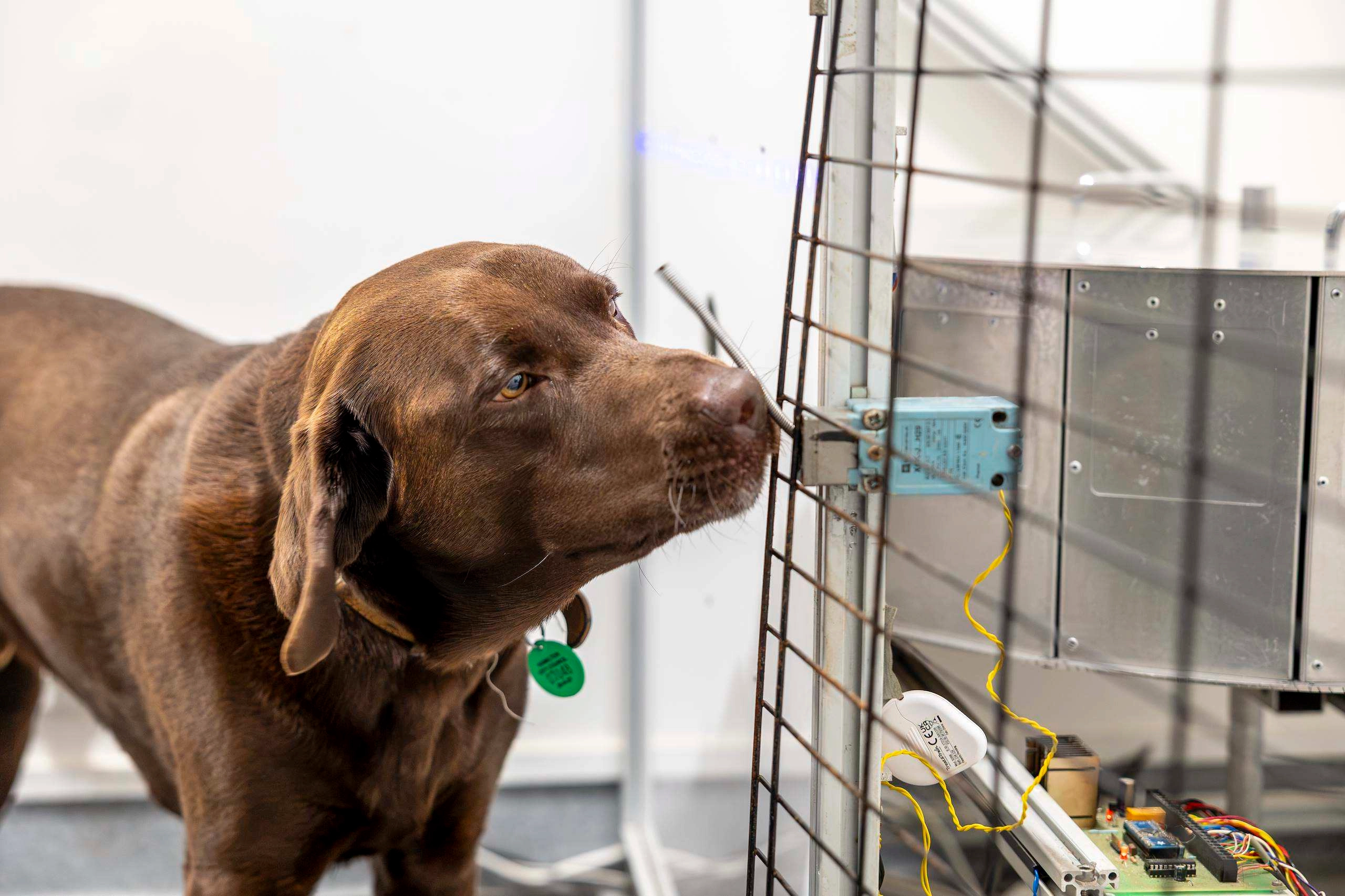
The research, published in the journal Learning and Motivation (opens in a new tab), involved six dogs trained to identify a target mixture of four odours using an automated scent-detection system.

Ora engaged in a scent detection task, using an olfactometer scent apparatus and a treat and train feeder.
The dogs completed scent-detection sessions either before or after their morning meal. Their average rate of correctly identifying the target was around 90% in both conditions.
But when the dogs were hungry, their ability to reject incorrect scents dropped significantly – meaning they produced more false alarms.
Co-author Dr Jade Fountain, who was involved in the study while a PhD candidate at Adelaide University’s School of Animal and Veterinary Sciences (opens in a new tab), says the finding could have implications for dogs working in environments where accurate scent detection is critical, as well as companion dogs involved in scent work sports.
“For working dogs, a false alarm can matter just as much as a missed target, particularly when they are being used in situations where people rely on them to distinguish one scent from another,” Dr Fountain says.
Dogs are increasingly used for scent detection in fields including conservation, disease detection, explosives and landmine detection.

Dr Fountain with her friends' dog, Monty
The researchers caution that the findings do not mean working dogs should simply be given a large meal immediately before every job. Feeding strategies need to take into account the type and intensity of work, as well as individual dogs and how they are trained and rewarded.
“Our results suggest feeding strategies could be one factor worth considering when planning scent-detection work, although we need more research to understand how these findings translate to operational settings,” Dr Edwards says.
The researchers suggest hunger may make food a more powerful motivator, potentially causing dogs to respond more broadly to smells resembling the target rather than being as selective in their responses when they are working for food.
The study also found considerable individual variation between dogs, highlighting the need for further research into how factors such as diet, training, reinforcement and working conditions affect scent-detection performance.
A separate paper published in Behavioural Processes (opens in a new tab) found that the dogs that had not eaten breakfast were more likely to whine and pay attention to the food dispenser, although they remained engaged with the scent detection tasks.

Buddy at work
Dr Fountain says the results are an important reminder that even highly trained dogs can be influenced by factors that may seem unrelated to the task at hand.
“Dogs are incredibly capable scent detectors, but their performance is influenced by more than their noses,” she says.
“Understanding how factors such as hunger and motivation affect their decisions could help us get the best possible performance from dogs working in scent-detection roles.”
The research is published in Learning and Motivation and Behavioural Processes.