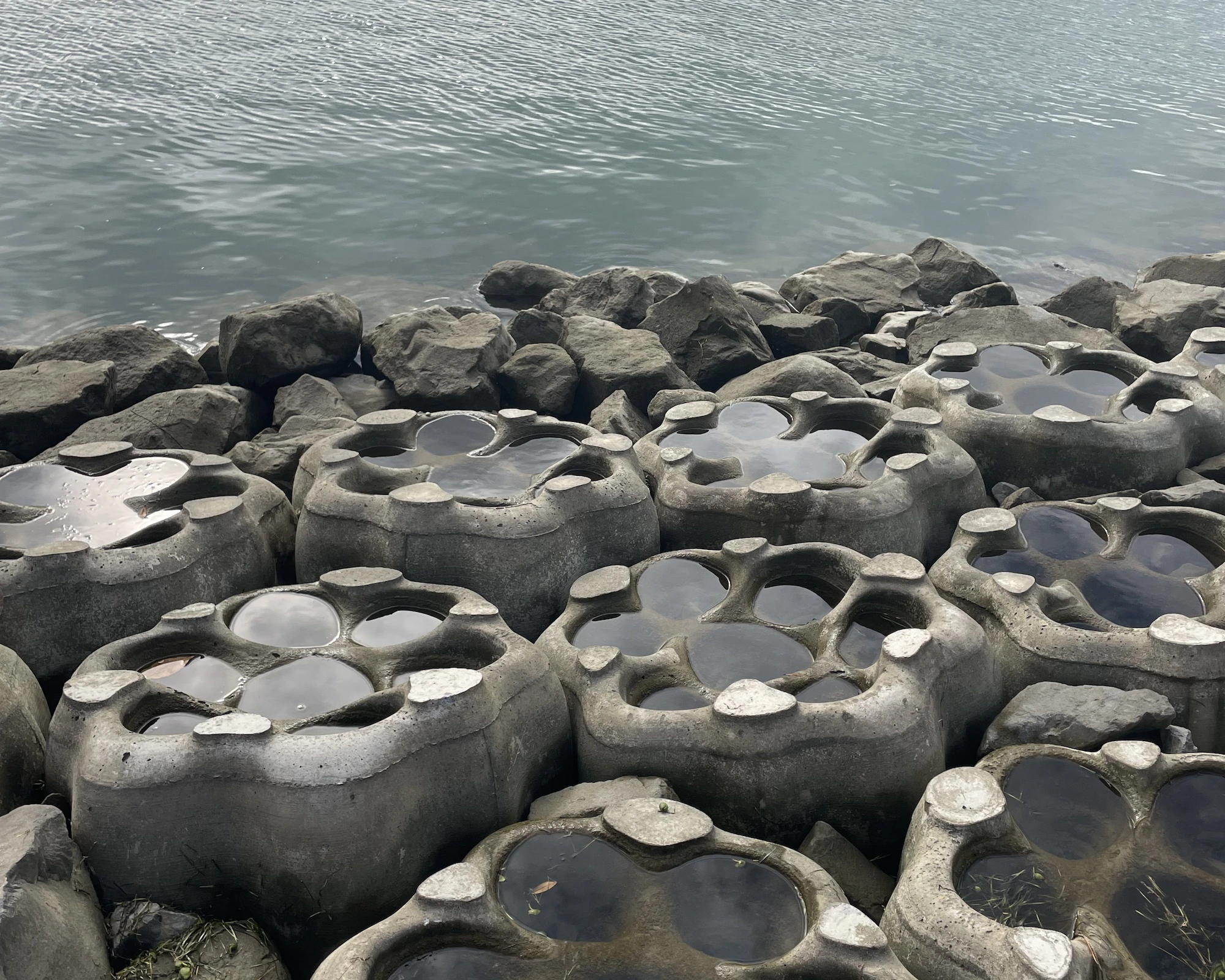
While visitors to the Tauranga waterfront may initially be drawn in by the sounds of happy, squealing children at its new harbourside playground, look just a little further toward the water and you will spy another exciting feature that’s thriving – its seapods.
Monitored in partnership by the University of Waikato and Toi Ohomai, the seapods are the first of their kind in New Zealand and designed to encourage new marine life within Tauranga Harbour. They form part of a living seawall, an initiative by Tauranga City Council and sponsored by Port of Tauranga, which includes 100 seapods that resemble a rocky tidal pool, with pockets that fill with water when the tide is in and retain the water when the tide goes out.
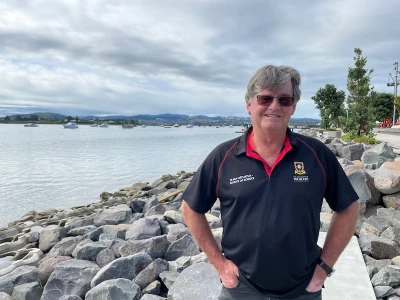
Professor Chris Battershill at the living seawall where the seapods are located.
On a sunny Wednesday morning, the University’s Professor Chris Battershill stopped in to check how the seapods are getting on, almost one year since they were installed.
“They’re doing well – there was initial concern that the seapods’ pockets might fill with sediment, but that hasn’t been the case. It’s a good sign the seapods are well designed. It also shows sediment load discharges from catchments in the hinterland (areas of land where rain flows into a body of water) are improving thanks to active management by Tauranga City Council and Bay of Plenty Regional Council. It tells you things are settling in the water quality in the harbour, too.”
Professor Battershill says that despite a few “marine heat waves” recently, where the water has been 2-3 degrees higher than normal sea level temperatures, there is still a lot of algae growing in the seapods.
“These are the start-off points for grazing animals like sea snails so we’re seeing the beginning of biodiversity there. Before long I expect oysters and all the animals that feed on those.”
Taylor Rabbitt, a summer student at Toi Ohomai who is on-site monitoring the seapods to measure increase of biodiversity over time, says she’s observed glass shrimp, cushion stars, bryozoans (also known as moss animals), ascidians (known as sea squirts) and triplefin fish.
“We have been monitoring the seapods since May 2024 and intend to continue for multiple years. So far, the findings indicate that much more stuff is living in and on the pods, compared to the surrounding, more traditional seawall, which means they are working as intended,” says David Culliford who is leading the research at Toi Ohomai.
While chatting, Professor Battershill pauses for a moment to watch a young boy and his mum as they peer into the seapods, the child’s small fingers pointing out life under the water.
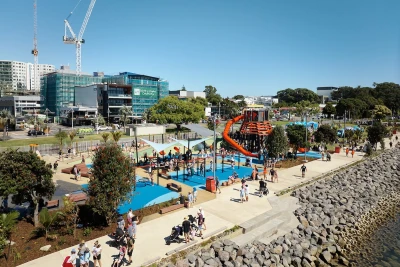
The seapods are located alongside the new playground on Tauranga's waterfront.
“It’s wonderful seeing young people exploring these spaces. Everyone likes to look in a tide pool and there are some interesting things to see now – there’ll be small kina in there. These are like a natural touch pool you might’ve seen at an aquarium, but they’re right here and they’re free. A lot of the marine life that grows here is really tough, so it’s fine for kids to head down and take a look around and poke their fingers in there – within reason.
“This is where you get your future marine science recruits,” he adds with a proud smile.
Along with establishing new marine life along the harbour’s edge, the seapods are also contributing to an international research programme.
“This is part of brilliant international experiment linked in with Sydney Institute of Marine Science, with similar pods deployed around Sydney Harbour. That collaboration will tell us a bit about what happens in each place, finding commonalities and, if there are differences, why that might be and which systems work best,” says Professor Battershill.
Further along the city’s new coastal walkway is a blue, sneezing sponge named Te Awanui, “the only one of its kind in the world”.
The sponge was discovered in January 2024 while works to restore and enhance the harbour and coastal walkway were underway. It was temporarily relocated to ensure it was protected during the construction work and Professor Battershill says since they’ve reinstated the sponge to its original location it’s been settling in well.
“The sponge restoration is another of the unique experiments we’re undertaking to see how we can enhance biodiversity. The sneezing sponge has been restored on a reclaimed and refreshed rock wall and is doing extremely well – fish are abounding there.”
Explore recent observations of the seapods.