Deciding where a patient should recover after surgery can be a life-changing decision, a topic that helped University of Waikato student Jolene Jones win this year’s Three Minute Thesis (3MT) competition held at the Gallagher Academy of Performing Arts.
Jolene, a PhD student from Te Wānanga Waiora Division of Health, competed against nine other doctoral candidates. Each had just three minutes to explain their complex research to a non-specialist audience.
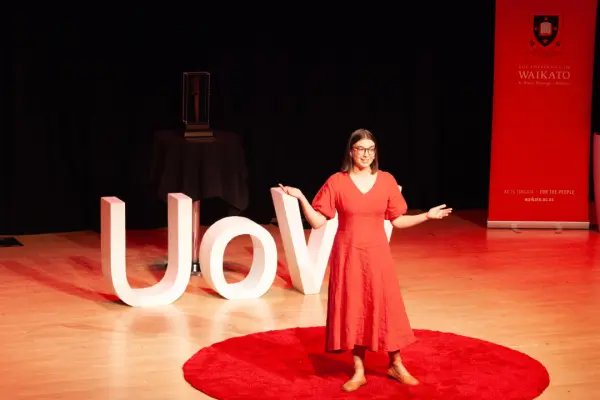
Jolene Jones during her 3MT presentation
Her talk, titled Too Sick for a Ward, Too Well for Intensive Care: Filling the Gap, explored the challenge of caring for patients who need more support than a general ward can provide but do not require intensive care.
Jolene’s research is inspired by her experience as a nurse, having worked across surgical wards and in post-anaesthetic care units.
“I have found it a compelling topic because of the potential to be really impactful for patients. But also, the potential to make the work environment a lot better for health staff.”
Jolene posed the question to the audience: “If I asked you when something is most likely to go wrong with surgery, you’d probably say during the operation, but you’d be wrong."
She explained that because surgery itself has become remarkably safe, the riskiest period is actually the recovery after the surgery.
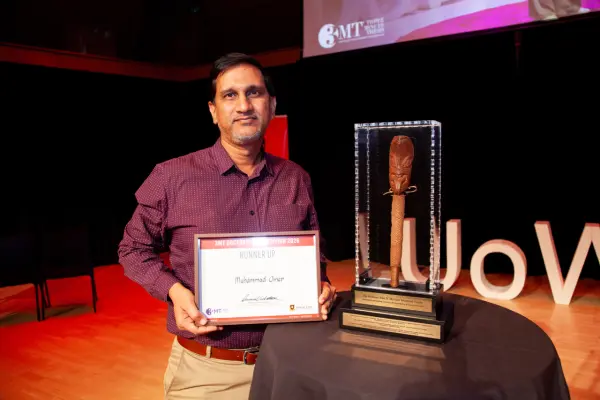
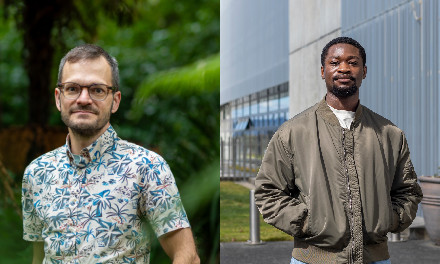
Muhammad Omer was runner-up in the 3MT competition
“Most people recover well on a standard surgical ward, and a small group require intensive care, but a growing group of patients sit in between, not sick enough for intensive care, but too complex for a ward to manage safely.”
Her research explores a new hospital unit called enhanced care, built for this gap. Unlike a standard ward, enhanced care can both monitor patients closely and act on what it finds, providing treatments previously only possible in intensive care. When patients stabilise, they continue their recovery on a surgical ward.
Entering the competition was a last-minute decision for Jolene. After studying part-time for two years while working as a nurse, a scholarship enabled her to begin studying full-time this year and step outside her comfort zone by “embracing student activities” such as 3MT.
“It's just been really cool meeting people from really different academic backgrounds and different schools. They've been a really wholesome group of people to spend time with.”
The three-minute time limit and the need to make her research accessible to a general audience presented challenges.
“I had to explain the problem, what I’m researching and why it matters, without oversimplifying it or losing important details,” Jolene says.
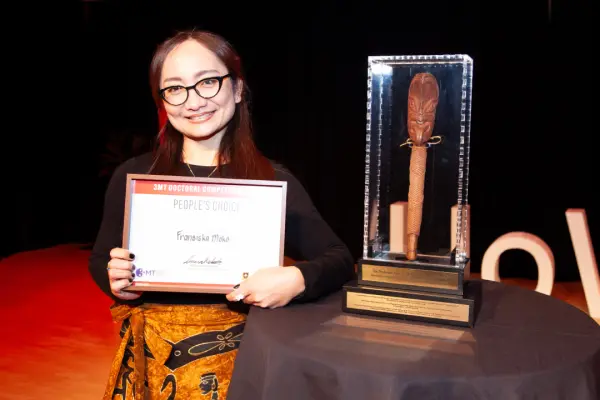
People’s choice went to Fransiska Moko
Runner-up Muhammad Omer presented 3D-Printed Metals: Heat clues to fatigue failure, having been drawn to the topic as an opportunity to help solve one of its key challenges.
“My research looks at how much repeated loading a newly printed metal can safely withstand before it fails. This type of progressive damage, known as fatigue, is the most common cause of mechanical failure. Using thermal imaging, my research aims to estimate the fatigue performance of metals in about an hour rather than through weeks of conventional testing."
He enjoyed finding a way to explain his research so that someone with no engineering background could understand and relate to it.
“The hardest part was deciding what to leave out. As researchers, we are passionate about every detail of our work, but not every detail is important to a general audience. The process forced me to think differently, focus on the bigger story, and find examples and analogies that people could connect with. It was demanding, but I genuinely enjoyed the journey.”
People’s choice went to Fransiska Moko from Te Ngira Institute for Population Research for her speech on When a marriage ends, the story doesn’t: women’s hidden struggles in Indonesia.
Deputy Vice-Chancellor Research Professor Gary Wilson said the event was an opportunity to celebrate doctoral researchers, whom he described as “the engine of our research effort at the University of Waikato”.
“We acknowledge that they’ve taken on the challenge of explaining why their research is important and valuable, and how the findings are impacting real world challenges.”
The finalists can be seen here (opens in a new tab).