Brazilian writer and theatre practitioner Gisela de Castro, a PhD candidate at the University of Waikato, has launched a digital storytelling platform that explores how children across New Zealand are thinking about climate, place and the future, while investigating how digital tools may reshape children’s literacy.
The platform, A Flight Over Aotearoa New Zealand (AFOA.NZ), features 22 short animated stories based on handwritten and typed letters from children aged between four and fifteen. The project received 70 letters representing 15 of New Zealand’s 16 regions, with many children writing about local environments, towns and coastlines, as well as their hopes for the years ahead.
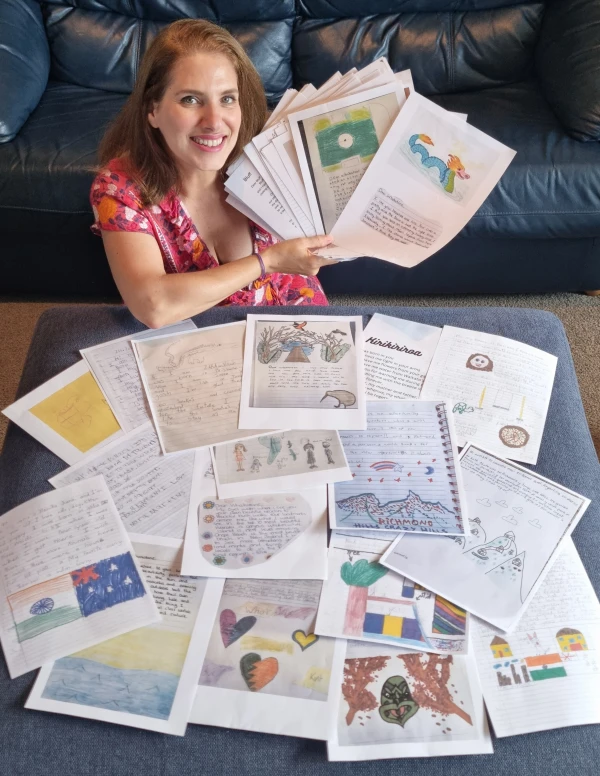
Gisela de Castro with all the children's letters from across 15 of the 16 regions of New Zealand
Transforming the letters into animations became a multidisciplinary creative collaboration. Gisela worked with seven animators, three musicians, an editor, a crochet artisan and a web designer to adapt the letters into digital stories combining text, illustration, narration and sound. The animations encourage children to view reading and writing as expressive acts and to see themselves as authors, artists and creators.
Gisela hopes the platform will encourage schools, families and communities to explore new ways of reading and writing, and to consider how digital and creative tools may shape the next generation of literacy practices.
“Children are often spoken for by adults. I wanted to create a space where they could speak for themselves,” Gisela says. “Their letters show a strong sense of place and a thoughtful awareness of the environment. Children are paying attention to the future, and we should take that seriously.”
Gisela describes the platform as an “affective map” of New Zealand that sits at the intersection of geography and literature. The project encourages children to imagine their towns and regions not only as places, but as characters with futures. “If your region were a person, what would you say to them in the future?” Gisela asked participating students.
Some children imagined new attractions for their communities, while others reflected on the places that hold personal memories. Ava from Northland wrote: “Whangarei, it would be cool if you had a water park themed like Candy Land, and it is free! So people who don’t have a lot can still go to the water park and have lots of fun.”
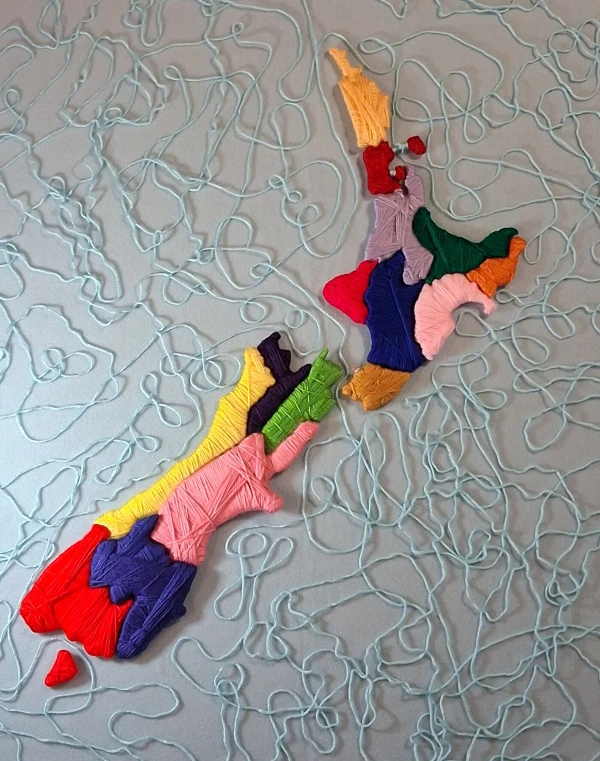
AFOA.NZ original artwork showcased at the Gallagher Academy of Performing Arts
Charlie from Invercargill focused instead on protecting places that matter to him: “I loved sailing at Lake Dunstan. I do hope this lake is not harmed in any way, so others can create the fond memories I have. I really love you, Cromwell, a lot.”
The idea to collect children’s letters draws inspiration from letters sent to Queen Elizabeth II by Australian schoolchildren in the 1980s and from the letter request made by Jacinda Ardern during the Covid-19 pandemic. These prompts demonstrated how ready children are to express what they notice and care about when they are invited to do so.
The research began with a nationwide call for participation. Gisela contacted more than 2,500 schools and initially received limited responses, before participation grew through exhibitions, social media and personal outreach. Letters arrived from urban and rural schools, coastal and inland communities, and from children whose understanding of the world was shaped by weather, family, landscape and daily life.
“Reading and writing are shifting into digital spaces. The question for educators is how we make sure that shift expands participation rather than narrows it,” Gisela says. “When children saw their stories animated, they began to see themselves as writers and artists. Confidence is part of literacy too.”
Gisela’s doctoral research in Screen and Media Studies examines how digital platforms can support engagement and participation, particularly for early readers and children with diverse learning needs. Her interest in inclusive children’s literature began in Brazil, where she created an award-winning children’s book incorporating sign language, oral narration and visual storytelling for children with hearing impairments. That work informs the current platform, which includes voiceover narration across all animations.
The project also reflects how children are encountering emerging digital tools. One participant rewrote a letter originally generated by artificial intelligence to better represent his own perspective, demonstrating how digital media can prompt children to think critically about authorship and authenticity.
The platform functions as both an interactive video book and a digital time capsule, preserving children’s voices for future readers and researchers. To highlight both environmental protection and the connection between digital storytelling and handcrafted art, Gisela invited artist Ana Charret to create the platform’s crochet mascot avatar.
The mascot represents tara iti, the New Zealand fairy tern, one of the country’s most endangered birds.
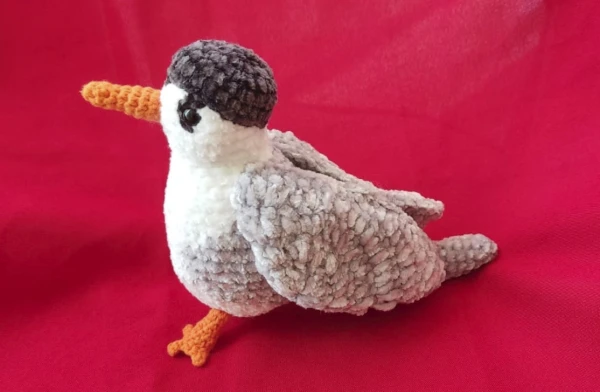
Tara iti crochet by Ana Charret
Gisela says the choice reflects her own experience as a migrant and echoes themes found in many of the children’s letters. “As someone who has travelled across the world, I wanted the project to express feelings of care and protection for the places we call home. Those same feelings appear in many of the children’s letters.
“Children are navigating a world shaped by environmental uncertainty and rapid technological change,” she says. “We need to consider what literacy looks like in that context and how we support children to participate in it.”
The launch marks a milestone in Gisela’s doctoral research, with further analysis and academic outputs to follow as she prepares for thesis submission in 2026 and oral defence in 2027.
The digital platform is now live and available for public viewing: https://www.afoa.nz/. Additional work is underway to further enhance website accessibility.