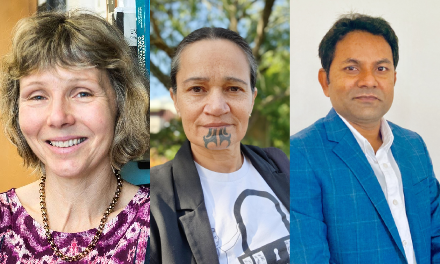
[L-R] Professor Kim Pickering, Professor Waikaremoana Waitoki and Dr Dalour Beg.
The University of Waikato is celebrating the success of three academics recognised as this year’s Royal Society Fellows Te Apārangi honours and with Rangapū Rangahau research funding respectively.
Professor Kim Pickering and Professor Waikaremoana Waitoki have been elected Ngā Ahurei a Te Apārangi Fellows, which will see them join the Academy of Fellows of the Royal Society Te Apārangi. The honour recognises researchers who are leaders in their fields.
Dr Dalour Beg, who is an Associate Professor in Te Kura Mata-Ao School of Engineering, has been awarded funding through the He Ara Whakahihiko Capability Fund’s Rangapū Rangahau scheme, which supports research connected to the Māori economy and New Zealand’s science, innovation and technology system.
Ngā Ahurei a Te Apārangi Fellows
Professor Kim Pickering, from Te Kura Mata-Ao School of Engineering, is recognised as a global leader in sustainable materials engineering. Her work focuses on developing high-performance materials from bioderived, recyclable and biodegradable resources.
Her research has advanced the use of plant fibres and waste products as alternatives to traditional plastics, improving their strength, durability and environmental performance. These innovations are already being used in products such as boats, buildings and 3D printing materials.
Professor Pickering says it’s wonderful to receive such recognition from the Royal Society.
“Highlighting the importance of this will be invaluable to encouraging and accelerating uptake to improve societal sustainability to help leave the best world we can for future generations,” Professor Pickering says.
Professor Waikaremoana Waitoki (Ngāti Hako, Ngāti Mahanga), from Te Pua Wānanga ki te Ao Faculty of Māori and Indigenous Studies, is recognised for her international leadership in Indigenous psychology and her work to decolonise health systems.
A clinical psychologist and a leader in Indigenous psychology, her work focuses on improving Māori wellbeing and making psychology more inclusive of Māori knowledge and perspectives.
Professor Waitoki was led to this work to address the decades-long lack of sustainable action to address systemic racism in psychology.
“Mātauranga Māori has immense potential to be an alternative to the dominance of mainstream psychology. Our combined efforts to work with, and for Māori, contributes to that potential,” Professor Waitoki says.
Her research addresses the impacts of systemic racism and wider social factors – such as housing and employment – on health outcomes, while supporting more equitable and culturally grounded approaches.
Professor Pickering and Professor Waitoki will be formally inducted into the Academy of Fellows at a ceremony in Wellington in April.
Rangapū Rangahau research funding
The Ministry of Business, Innovation and Employment has also announced successful projects funded through its Rangapū Rangahau fund, including one led by Dr Dalour Beg.
Dr Beg’s project focuses on developing scalable, eco-friendly mechanical processing techniques to transform harakeke into soft, high-quality textile fibres and yarns.
In partnership with Muka Innovations and iwi, the two-year project will create sustainable pathways for producing premium textiles from harakeke – unlocking new Māori-led economic opportunities while supporting sustainable cultivation and contemporary product development.
“My aim is to reduce the cost of muka (fibre of New Zealand flax) to as little as one-eighth of hand-extracted fibre – making this treasured harakeke taonga truly accessible and unlocking its full potential though genuine partnership,” Dr Beg says.
An internationally recognised materials scientist with more than 20 years’ experience, Dr Beg’s work spans natural fibre composites, biodegradable plastics and biomaterials, combining fundamental science with practical, industry-ready applications.
This includes developing high-performance materials from New Zealand fibres blended with recycled plastics and paper, as well as creating biodegradable alternatives to fossil-based plastics.
Dr Beg has secured significant research funding both internationally and in New Zealand and currently leads a $1 million MBIE Smart Ideas project on cellulose-based foam to replace polystyrene.
The latest Rangapū Rangahau investment will see $5.95 million distributed across 17 projects, each receiving $350,000 over two years to support research that strengthens the Māori economy and benefits the environment.