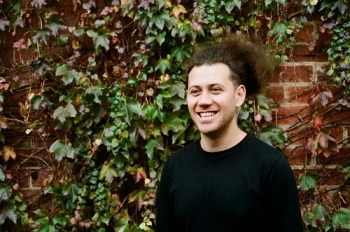
Liam Wooding photographed by Ruby Shirres
Liam (Ngāti Hinearo, Ngāti Tuera, Te Ati Haunui-a-Pāpārangi) has been awarded a Fulbright NZ General Graduate Award to study at the University of California San Diego (UCSD) to research music performance – study that will feed into his Waikato Doctor of Musical Arts (DMA).
He's chuffed about being awarded the Fulbright scholarship.
“This is a great opportunity to expand my thinking – a continuation of my current work, but with new input and a new environment. I’ll also be able to audit classes and probably gain some further teaching experience.”
Liam will have mentorships with percussion professor at UCSD Steven Schick, who he knows already, and piano professor Aleck Karis.
His Waikato University supervisor is Professor Martin Lodge, Convenor of Music and Head of Composition at the University and a prominent New Zealand composer.
He’s the main reason Liam chose to return to Waikato.
“I wanted to work with someone who understood the world of New Zealand music and its particular issues,” Liam says.
His DMA topic is New Zealand piano music and he works with Professor Lodge long distance.
In 2017, having completed his Master of Music at Waikato, Liam headed to Melbourne to complete the Professional Performance Program at the Australian National Academy of Music.
“The high-performance environment at the Australian National Academy created a huge shift in me and put me on the path I’m on now,” he says.
Liam’s first commercial recording, Play Pen, was released on the Atoll label in 2019, the same year he graduated in Melbourne. The album spent several weeks at the top of the Radio New Zealand classical music charts. In 2020 Liam was an artist in residence at the Banff Centre for Arts and Creativity in Canada.
These days he’s mostly practising, reading and writing “or scribbling” for his doctorate.
“I perform a bit around Australia and New Zealand too, and I also teach at the Western Australian Academy of Performing Arts in Perth where I’m now based.”
His performances tend towards 20th century composers and New Zealand composers in particular.
“When it comes to choosing a concert programme, it’s often what I’m interested in at the time – ticking off works I feel I need to play, but there’s a brand aspect to it as well,” he says. “Pianists do gain a certain reputation by the music they play – think Michael Houstoun and Beethoven, they’re two peas in a pod. For me, I’ve played a lot of 20th century repertoire; it’s a style and aesthetic that I connect strongly with and will continue to explore.”
Liam says there’s also an ethical dimension to programming and this is where the promotion of New Zealand music becomes important.
“A concert program communicates a set of values. It’s a chance to tell a story about music and culture, but also what’s important to you. Playing music that is and of contemporary New Zealand is an important strand of my musical life – it’s a way that I can bring my musical world with the world around me closer together.”
As a child growing up in Whanganui, Liam didn’t see himself as a performer, but once he started learning the piano he worked through the grades and became a regular collaborating musician, playing in chamber music groups and as an accompanist.
“Playing the piano was something that made me feel good and I was good at it, helped by the fact I had a great teacher in my early years. Now I’m getting a bit older, and probably in part because of the pandemic, I’ve reassessed what I want to do musically, and I know I want to play more as a soloist.”
Liam will take up his Fulbright award in January and will be based in the USA for the year.