Engineering for low-cost housing using cold-formed steel
University of Waikato engineering researchers are rethinking the future of building design by focusing on cost-effective, sustainable and environmentally responsible solutions that still meet people’s design expectations.
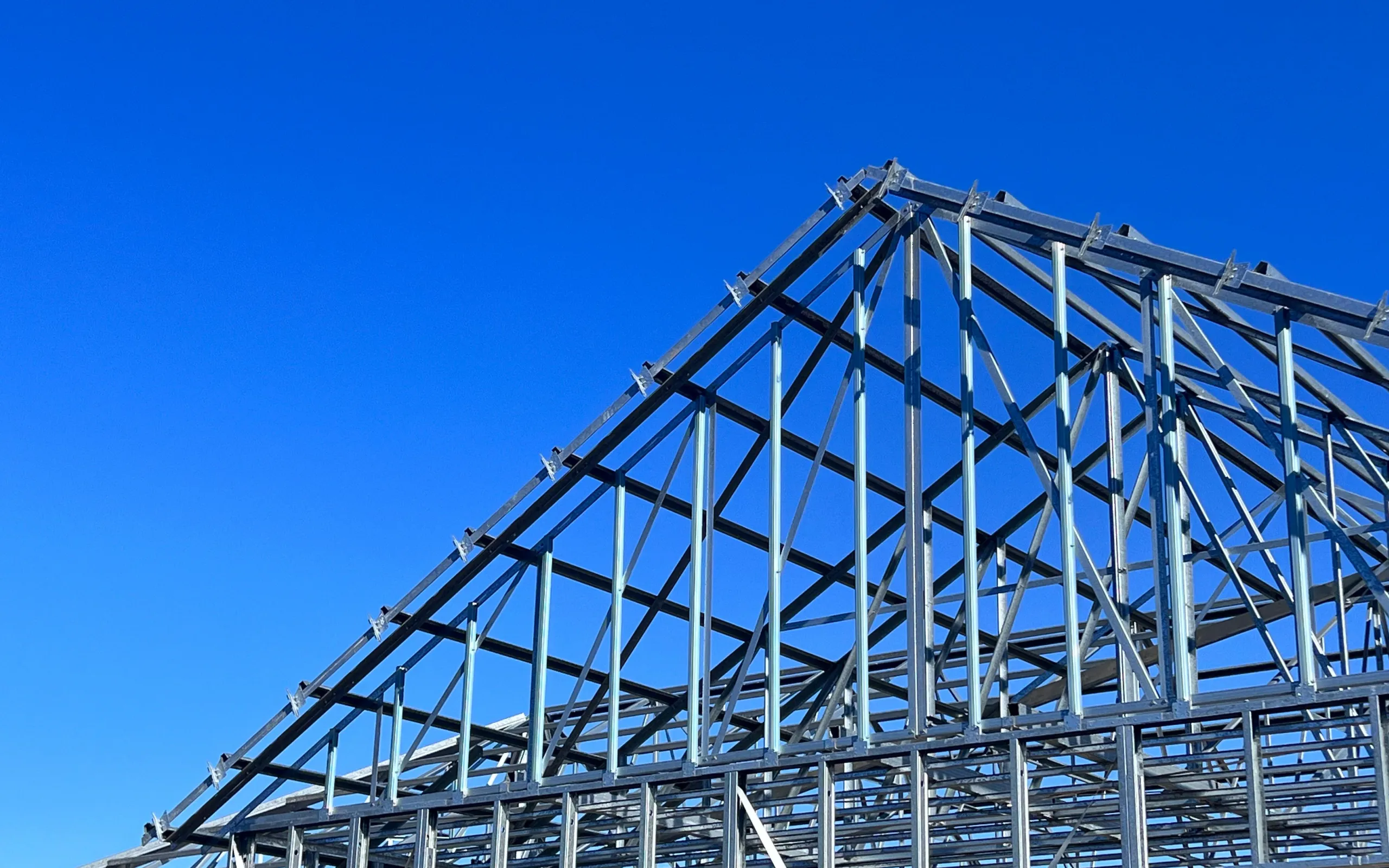
Our team is exploring the potential of cold-formed steel buildings as a sustainable, low-cost housing solution. Our focus is on developing new building systems and configurations that incorporate additional stiffening and support, increasing strength and enabling longer spans than are typically achievable with conventional systems. We are working to understand the steel’s structural behaviour through experimental testing and advanced computer modelling, examining both load-carrying capacity and bending performance. Fire performance is also a key part of our research.
At the heart of this work is a manufacturing method that shapes steel without heat, unlike conventional steel forming processes that require reheating. Cold-formed steel is produced at room temperature by roll-forming flat steel coils into structural sections. This process uses significantly less energy than hot-rolled steel manufacturing, reducing embodied energy and associated emissions.
While cold-formed steel has been studied internationally, our research contributes new knowledge by developing and validating improved cold-formed steel member designs and design approaches tailored to residential construction. By integrating structural testing, numerical modelling, cyclone and fire performance assessment, as well as cost and environmental analysis, the work advances global understanding of cold-formed steel systems while also providing New Zealand-specific evidence to support their adoption in affordable housing.
Historically, building materials have prioritised safety and resilience with little consideration given to what happens at the end of a building’s life. Cold-formed steel is highly recyclable and can be reused or recycled at end of life rather than sent to landfill, helping to reduce waste and environmental pollution compared with some other building materials.
Our research includes analyses of direct cost and environmental impact, which show reductions in material and labour costs, lower on-site fabrication requirements and faster build times. Together, these benefits suggest that cold-formed steel could help ease New Zealand’s long-standing housing crisis. Over the past 20 years, New Zealand has experienced some of the fastest house-price growth in the Organisation for Economic Co-operation Development (OECD) (opens in a new tab), with several cities recording median house prices more than five times the median household income.
Cold-formed steel buildings are also well suited to New Zealand conditions, where single- and double-storey homes dominate and extreme weather events such as cyclones and flooding are becoming more frequent. Our research supports the goals of the United Nations Paris Agreement (opens in a new tab) and aligns with New Zealand’s Climate Change Response Amendment Act 2019 (opens in a new tab) target of net-zero carbon emissions by 2050 through its focus on sustainable housing solutions.
Globally, demand for sustainable housing is increasing. In New Zealand, approximately 90% of residential framing is currently timber. While cold-formed steel represents a small share of the market, its high recyclability, cost effectiveness and performance at end of life position it as a viable and sustainable alternative.


2025 Highlights
Our team is focused on advancing sustainable housing outcomes through evidence-based evaluation of construction materials that balance environmental performance, structural reliability and cost-effectiveness.
Low-carbon building innovation
Our researchers investigated the environmental impacts of housing using life-cycle assessment methods, exploring how alternative material choices can reduce carbon emissions while maintaining strong structural performance and affordability. Our life-cycle assessments involved evaluating how material choices influence carbon outcomes, from production to end-of-life reuse.
Performance and resilience
Our team investigated how cold-formed steel’s strength, stability and durability can be enhanced through changes in section shape, stiffeners, connections, and protective coatings. Using experimental testing and advanced computer modelling, we examined load capacity, seismic behaviour, fire performance, and cyclone resilience. Our insights will help inform more reliable design methods, ensuring homes are built to handle New Zealand’s climate and extreme weather events.
Affordable housing solutions
Through detailed cost and environmental analyses, we demonstrate how the use of cold-formed steel in housing construction can reduce material and labour costs, minimise on-site fabrication and accelerate construction timelines. By highlighting the potential of cold-formed steel to improve build efficiency, our research contributes to an understanding of a practical pathway to increasing housing supply and affordability in New Zealand.
Citations
Ananthi, G. B. G., Chandramohan, D. L., Mandal, D., & Uzzaman, A. (2025). Flexural strength of cold-formed steel unstiffened and edge-stiffened hexagonal perforated channel sections. Buildings, 15(15), 2679. https://doi.org/10.3390/buildings15152679 (opens in a new tab)
Dai, Y., Raftery, G. M., Roy, K., Hajirasouliha, I., Fang, Z., Chen, B., & Lim, J. B. P. (2024). Experimental and numerical investigation on flexural behavior of novel unsymmetrical cold-formed steel built-up stiffened box sections. Journal of Structural Engineering, 151(2). https://doi.org/10.1061/JSENDH.STENG-13833 (opens in a new tab)
Dani, A. A., Feng, R., Fang, Z., & Roy, K. (2025). Life cycle assessment of a structural insulated panel modular house in New Zealand. Buildings, 15(1), 146. https://doi.org/10.3390/buildings15010146 (opens in a new tab)
Gurupatham, B. G. A., Roy, K., & Lim, J. B. P. (2025). Effect of stiffeners on the axial strength of face-to-face unequal-angle cold-formed steel columns. Buildings, 15(1), 88. https://doi.org/10.3390/buildings15010088 (opens in a new tab)
Pourmasoud, M., Hajirasouliha, I., Lim, J. B. P., & Behzadi, A. (2025). Experimental and analytical investigation of a new three-dimensional seismic isolation under coupled horizontal–vertical excitations. Journal of Earthquake Engineering, 29(7), 1532–1557. https://doi.org/10.1080/13632469.2025.2484602 (opens in a new tab)
Roy, K. (2025). Editorial: Engineered for sustainability: Multi-material strategies in construction. Proceedings of the Institution of Civil Engineers – Construction Materials, 178(5), 189–190. https://doi.org/10.1680/jcoma.2025.178.5.189 (opens in a new tab)
Sam, V. S., Nammalvar, A., Iswarary, A., Andrushia, D., Ananthi, G. B. G., & Roy, K. (2025). Effect of protective coatings on post-fire performance and behavior of mild steel-based cold-formed steel back-to-back channel columns with bolted connections. Fire, 8(3), 107. https://doi.org/10.3390/fire8030107 (opens in a new tab)
Thangavel, P., Palanisamy, M., Kumar, D. R., Wipulanusat, W., Sunkpho, J., & Roy, K. (2025). Investigation of cold formed steel angle compression through high throughput design FEA and machine learning. Scientific Reports, 15, 19222. https://doi.org/10.1038/s41598-025-03991-9 (opens in a new tab)