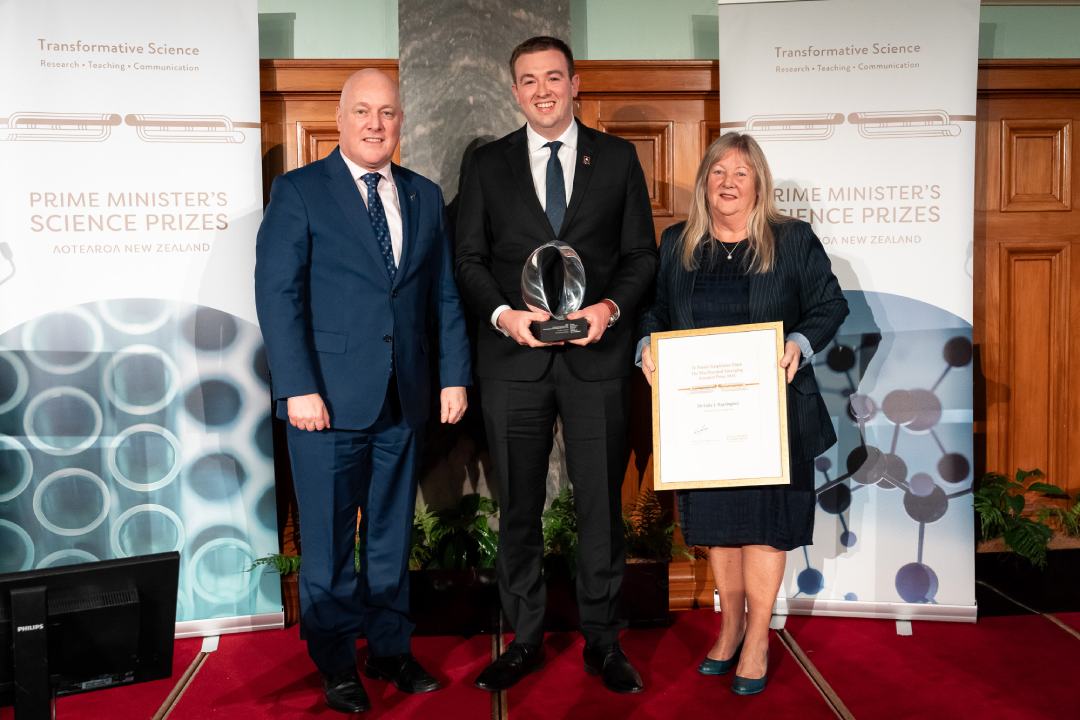
Parekawhia McLean (Waikato, Ngāti Maniapoto) received a Distinguished Alumni Award from the University of Waikato in 2014, recognising her impact on public policy and in the public sector.
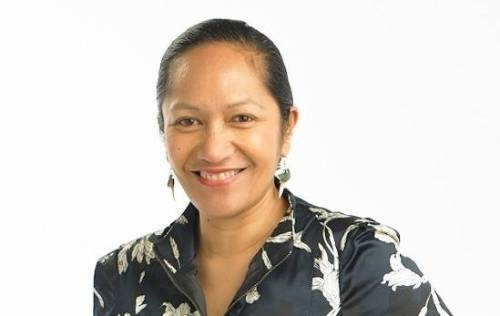
Distinguished Alumna Parekawhia McLean says her upbringing, surrounded by whānau, gave her a strong sense of the importance of helping others.
Since 2014, these contributions have continued, and she remains committed to the economic and social betterment of her tribe, Waikato-Tainui, where she was Chief Executive for six years and is now Chair.
Her success in the public sector is well-documented, but perhaps lesser-known is her journey to her studies and the impact her whānau has, and continues to have, on her motivation to help others.
Whatawhata origins
Parekawhia is quick to acknowledge her upbringing, surrounded by whānau, as the foundation of her career. She and her seven siblings were brought up on a farm in the hill country of Whatawhata, towards Raglan in Waikato, where the family had lived for 40 years as tenants until the land was returned to her tribe, Waikato-Tainui, in 1995.
“My primary schooling was at Whatawhata Primary School, which back then was quite rural and I was lucky to have a lot of whānau attend at the same time. It was a wonderful part of my education and I think back on it often,” Parekawhia says.
While there wasn’t a lot of material possessions growing up, Parekawhia and her siblings had everything they needed, and a strong sense of the importance of helping others, a value that would go on to underpin her studies and career in the years to come.
After finishing secondary school at Hamilton’s Fraser High School, Parekawhia started studying at the University of Waikato, beginning a Bachelor of Social Sciences in 1984, and graduating with a Master of Social Sciences, majoring in sociology, in 1991.
“I have many lovely memories of studying at Waikato,” she says. “I remember lunches at Bongo café, and the road trip we did in the Māori department up north, staying on different marae, along with the Vice-Chancellor at the time, Professor Wilf Malcolm. I remember thinking how cool it was that he came with us, sitting in the bus with us students and having a laugh.”
Parekawhia says while she wasn’t overly studious, she had a strong work ethic and enjoyed her subjects.
“I quite liked studying. I could have easily kept going, but my dad sat me down and said it would be good for me to go away, go somewhere new.
“I didn’t want to leave, I was happy where I was, but Dad said ‘one day you will come back and make a contribution, but for now you should go.’ So off I went to Wellington. I was sad to say goodbye to whānau, but it turned out to be the making of me.”
Parekawhia began a career in public service that would see her working in a number of agencies, and contributing to landmark policy developments, including the valuing, preserving and rewarding of unpaid domestic work, alongside pioneering policy makers such as Dame Marilyn Waring (also a Waikato alumna), and Miriama Evans.
She went on to work in the then-Ministry of Māori Development (now Te Puni Kōkiri), and the State Services Commission, which opened her eyes to the “wider machinery” of government. She then travelled to the US for further study, completing an MA in Public Administration and Policy at the University of Wisconsin.
Back in New Zealand, Parekawhia worked as a strategic advisor within the Department of Prime Minister and Cabinet to three of New Zealand’s Prime Ministers – Jim Bolger, Jenny Shipley, and Helen Clark.
Waikato-Tainui
Parekawhia returned home in 2010, and to her tribe, as its CEO. Bringing with her significant public sector and policy experience, she set to work furthering the interests and wellbeing of Waikato-Tainui.
“Our focus has always been on investing in our people, whether that’s through housing, learning and employment, strengthening tikanga, addressing inequities in partnership with others, and ensuring our presence in local and central government. Overarching this are the principles of the Kīngitanga and the role it plays in our lives now and into the future.”
She left the role in 2016 but remains involved as Chair of Te Whakakitenga o Waikato – the governing body of the tribe.
“It is a privilege to work for my iwi and to follow in the footsteps of many others.”
Alongside several current governance roles, including as non-executive director for Gas Industry Company and as part of the steering group for the new Māori Health Authority, Parekawhia is currently Chief Executive of Te Kāhui Tātari Ture - Criminal Cases Review Commission, where she supports Commissioners to oversee the review and investigation of convictions and sentences.
In December, Parekawhia was appointed to the University of Waikato's Council and as chair of Te Rōpū Manukura, the Kaitiaki (guardian) of the Treaty of Waitangi for the University.