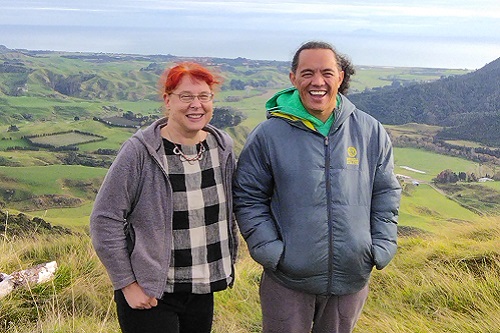
The purpose behind the waiata app “was providing the words of our Whakatōhea waiata to our Whakatōhea people, to learn our Whakatōhea words, and in hindsight our Whakatōhea kōrero tuku iho, our history," says Anita Kurei-Paruru.
“Our younger generation learn many waiata in school, and in particular our waiata mōteatea that are sung on our marae,” she says. “However some of our older iwi members did not know these mōteatea sung on the pae tapu (bench seat where the tangata whenua orators and singers sit on the marae). So providing access for them to learn these mōteatea at home, plus all our other tribal waiata, strengthens our whole iwi culturally, and enhances our identity as Whakatōhea.
Our kōhanga reo kids and kura tamariki are fortunate; they get to hear and speak reo every day, and sing the waiata of their iwi. Unfortunately there is a generation that missed [out on learning] te reo and the waiata we sing on our pae tapu, at our marae. So, creating a waiata app with the words provides them the opportunity to learn these waiata anywhere, and to be able to sing on their pae tapu.
Songs on the app are organised by genre, enabling people to scroll through and select appropriate songs to sing at different occasions, from a tangi (funeral) to a birthday. Mōteatea, or traditional poems and songs of lament, are also included.
“That old language is still alive in these waiata, and that is the best way of learning and preserving our Whakatōhea reo,” says Anita.
The project is part of an ongoing relationship between the iwi and University, supported by the Ministry of Business, Innovation and Employment’s Vision Mātauranga Capability Fund (opens in a new tab), with the aim of developing iwi digital capabilities.
“The app was created because the iwi was interested in preserving their waiata and making them available in digital form,” says Associate Professor Hinze. “The app design was guided and driven by the iwi and all waiata were provided by the iwi. It was important to both parties that the process was iwi-led, and that the app was co-designed by both researchers and iwi members.”
The project used Tipple (opens in a new tab), a location-based mobile app framework developed by Associate Professor Hinze. In the past, it has been used to create apps for the Hamilton Gardens, Christchurch City Council and Cambridge Museum.
University researchers and iwi spent time building their relationship, meeting face-to-face, and listening to understand what the tribe wanted. The project also gave local rangatahi an opportunity to learn more about computer science from University experts.
In the current app, Whakatōhea iwi members can access more than 30 iwi waiata by registering with the iwi. Lyrics on the app can be viewed in te reo Māori and English, and the app contains information on waiata history and authors, and will soon display accompanying guitar chords. In addition, the app provides three Whakatōhea waiata to the public: Nei rā te kaupapa, Te Tapu o Muriwai and Tērā te pō pango.
The app launched in June 2020, and has been well received by iwi members and is used regularly on the marae. Anita hopes it will be a springboard for iwi to learn more about Whakatōhea history.
It’s important to know who we are, where we came from, and what our ancestors had to go through. It’s given us mana and determination to do more and provide more to the next generation.
The waiata app is one of several projects that iwi and the University computer science team have collaborated on in recent years, including a digital library of taonga (iwi treasures and documents). Currently under development is another app on iwi and hapū stories and histories and a digital system to capture iwi members’ whakapapa (ancestral and family connections).
The waiata app is free to download on the App Store (Apple devices) (opens in a new tab) and Google Play Store (Android devices). (opens in a new tab)