

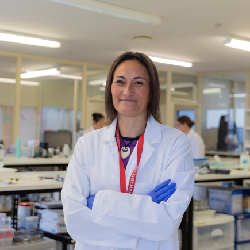
Kiri Reihana
Master of Science, Doctor of Philosophy

From Whakatāne to the University’s Tauranga campus, marine science researcher Jana Longney is investigating the remarkable ability of sex-changing fish as part of her Master of Science.
Whakatāne
Tauranga campus
For most people, a trip to the beach means a swim or a walk along the sand. For University of Waikato marine science researcher Jana Longney, it can mean collecting the next group of fish for her research.
Born and raised in Whakatāne, Jana grew up around water – fresh, salt, waterways and lakes. Time spent on the family farm and participating in outdoor sports sparked a fascination with the natural environment.
Her interest in water quality and aquatic ecology began in primary school and continued through high school, where she was the only student studying chemistry in Years 12 and 13.
A lot of the time I was immersed in nature. I enjoyed the practical aspects of science, particularly experimenting and exploring questions independently.
As the first in her family to attend university, Jana knew tertiary education would only be possible if she secured a scholarship.
She received the Te Paewai o te Rangi: The University of Waikato Scholarship for Outstanding Academic Achievement, the University of Waikato Research Masters Scholarship and the Women in Science Scholarship.
Alongside her studies, Jana worked at least 15 hours a week to cover living expenses while maintaining the academic results required to retain her scholarship. She also achieved her goal of completing her studies without taking out a student loan.
Jana chose the University’s Tauranga campus where she completed a Bachelor of Science before progressing to a master’s degree investigating the remarkable ability of some fish to naturally change sex.
Her research focuses on spotties, a species of wrasse found in New Zealand waters, which can change from female to male in response to changes in their social hierarchy.
Jana compares their social structure to a chicken’s pecking order. When a dominant male disappears, a female can begin the transformation, with her reproductive system changing over approximately three months.
Now pursuing her PhD, Jana is building on her master’s research by investigating the role of steroid hormones in triggering sex change. Her findings could contribute to a better understanding of fish reproduction, the effects of environmental contaminants, and reproductive management in aquaculture.
Throughout her studies, Jana has supported laboratory teaching and field trips, delivered statistics tutorials for undergraduate students, and shared her passion for science with school students through her role as a student ambassador.
For Jana, one of the biggest advantages of studying in Tauranga is having the marine environment on her doorstep.
As a technician working with live fish, she helps maintain research populations, sometimes caring for them for up to a year.
“I just go to the jetty and I fish my new cohort out there,” she says.
She also values the smaller classes, close relationships with lecturers and opportunities to build industry connections.
You’re currently viewing the website as a domestic student, you might want to change to international.
You're a domestic student if you are:
You're an International student if you are:


