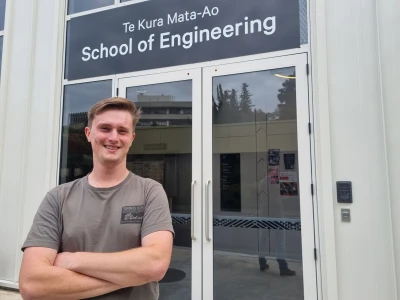
University of Waikato PhD Engineering student, Brayden Whitton
Brayden Whitton, from Te Kura Mata-Ao School of Engineering (opens in a new tab), is advancing ways to produce at scale cellulose foam – a biodegradable, sponge-like material that is emerging as a sustainable alternative to replace polystyrene in packaging.
Plastic pollution is a significant global challenge, and Brayden’s work has recently gained international recognition, winning the Australasian Pulp and Paper Technical Association New Speaker Competition in Melbourne. His presentation was recognised as both engaging and insightful, bringing strong technical knowledge and confidence to the stage.
“We’ve all experienced the frustration of getting rid of polystyrene,” Brayden says. “It crumbles easily, never fits properly in the rubbish bin, and often sits around for weeks until the next collection.
Materials of the future need to be more sustainable. As scientists and engineers, we have a responsibility to harness the strength of natural materials and develop practical, environmentally friendly alternatives.
Polystyrene (commonly known as styrofoam) is widely used in packaging and insulation but poses serious environmental issues. It is non-biodegradable, difficult to recycle, and often ends up in landfills or the natural environment. Its production also contributes to air emissions, and its bulky, lightweight nature makes recycling impractical in many countries, including New Zealand.
In 2025, 41 million tonnes were produced, with projections reaching around 62 million tonnes by 2034. Asia Pacific accounts for over 50% of the production capacity.
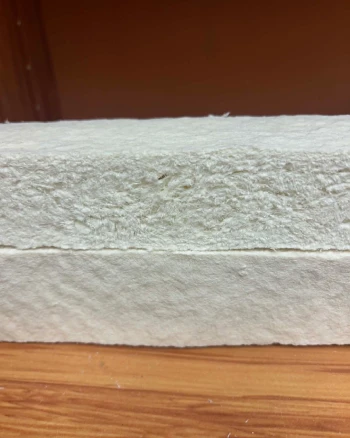
An example of cellulose foam made on the Hamilton campus
Lightweight yet firm, with a slightly springy, cardboard-like texture, it’s well suited to packaging applications. Brayden describes its appearance as somewhere between a dry kitchen sponge, puffed popcorn and marshmallows.
While cellulose foam shows promise – with research indicating it can match the strength of polystyrene – challenges remain around scaling production and ensuring commercial viability, Brayden says.
“One of the main issues is the drying process. As water is removed from the foam structure, it can collapse. Current methods can minimise this, but they are slow and energy intensive.
“To become a true alternative, we need to demonstrate that it can be produced efficiently at scale.”
Supervised by Dr Dalour Beg, (opens in a new tab) Associate Professor in the School of Engineering and Professor Kim Pickering (opens in a new tab) from the School, Brayden’s research focuses on understanding how different processing methods influence the material’s structure at each stage of production, with the aim of identifying the most effective and scalable approach.
“Improving our understanding of processing is key to advancing cellulose foam and making it commercially viable.”
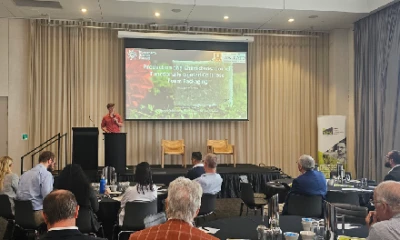
Brayden giving his presentation at the New Speaker Competition in Melbourne
Brayden says having the opportunity to be part of something bigger that can reduce our dependence on such a material is what drives him.
His research is funded as part of a $1 million Ministry of Business, Innovation and Employment Endeavour Fund – Smart Ideas project.