As living costs rise and fuel prices soar, community energy sharing could help cut costs and boost resilience, University of Waikato research shows.
A pilot project led by University of Waikato postdoctoral researcher Dr Min Zhang and Professor of Software Engineering Mark Apperley (opens in a new tab) from the University’s Ahuora Centre for Smart Energy Systems (opens in a new tab) focused on how households, schools and businesses on a section of the western side of Waiheke Island could share locally generated solar energy rather than relying solely on the national grid. Their study proves a concept that could be used in communities throughout New Zealand.
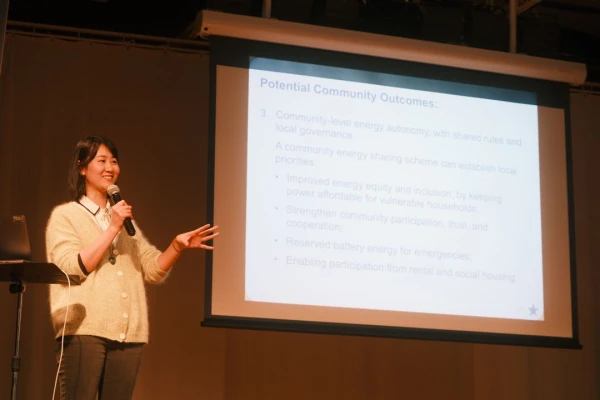
Dr Min Zhang
Working with local community group Electrify Waiheke, the Waikato researchers collected energy data from households, a vineyard, a pottery studio and a primary and high school to model how a local energy-sharing system could work.
The section of the island was chosen for its representation of the diverse makeup of residents, and the fact that many in the community are very interested in exploring this opportunity.
The concept allows households with solar panels and batteries to sell excess energy directly to neighbours at a lower cost than standard market rates.
“Instead of selling surplus solar power back to the grid at a low price, households can share it within the community, creating benefits for both buyers and sellers,” Dr Zhang says.
The study also highlights the potential for shared infrastructure, such as community-scale solar installations or a shared large battery, reducing the need for individual households to invest in expensive systems.
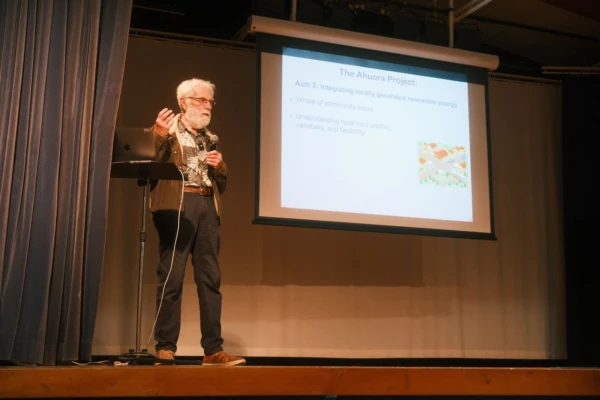
Professor Mark Apperley
She also notes the modelling shows even households without solar panels can save money by participating in the system.
Additional savings can be achieved by shifting energy use – such as hot water heating and electric vehicle charging – to off peak times when electricity is cheaper.
“So instead of charging your electric vehicle straight away after coming home from work, the price is cheaper at night, so you could charge it at night. Just as long as the vehicle was charged by the morning it doesn’t matter when it is charged.”
The study was based on the energy used over the last year, determined using household energy consumption data obtained from each household’s energy supplier.
Modelling showed that in an energy-sharing community of 200 households, those without solar could still achieve electricity cost savings of up to 16%, while households with both solar and battery systems could save up to 74%.
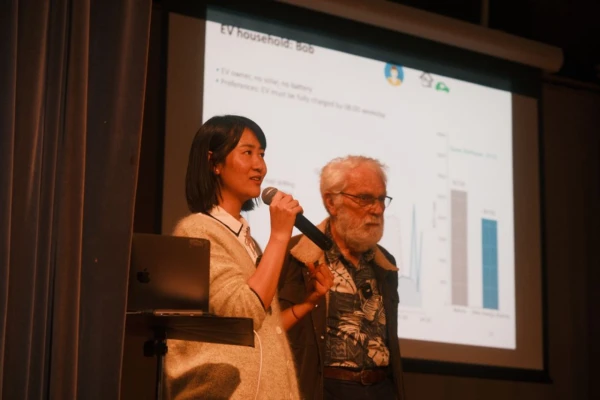
Dr Min Zhang and Professor Mark Apperley presenting to the Waiheke Island community
Currently, Waiheke Island’s power is reliant on a single submarine cable connected to the mainland.
“This means there is a risk of people losing power if there was a major incident like an earthquake. The cable also has limited capacity,” Dr Zhang says.
An increasing population on the Auckland island is driving higher energy consumption, with estimates suggesting the cable will require a costly upgrade within 10 years. Local energy sharing could help ease that pressure.
Dr Zhang says the concept has been well received by the community, with strong interest in both its financial benefits and its potential to support long-term sustainability.
She noted that around 10% of households currently have solar power and acknowledged that a key challenge will be encouraging more residents to invest in solar so the wider community can fully benefit.
“Many communities face similar challenges around energy costs and infrastructure constraints. This model could be adapted to improve affordability and resilience in other remote or infrastructure -constrained areas, such as Great Barrier Island, Stewart Island, and rural communities across New Zealand.”
She added that the concept of community energy sharing, combined with increased local renewable generation, has strong potential to be widely used across the country. By improving efficiency and reducing carbon emissions, this approach could deliver significant benefits nationwide, with Waiheke serving as an ideal case study.
The Ahuora Centre for Smart Energy Systems brings together researchers from Waikato, Auckland, Massey and international Universities. The Centre’s mission to is help create more sustainable New Zealand industries that sit in harmony with the environment and people through smart energy systems and integration.