This programme allows students to train to become qualified teachers while remaining in their local schools.
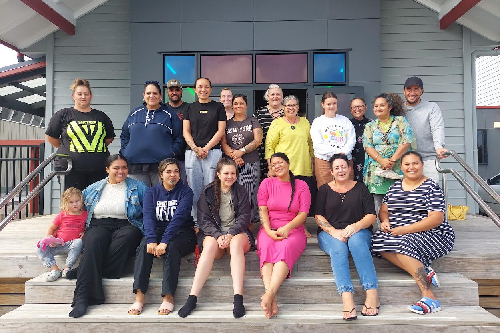
The students enrolled in the programme stand outside the Kaitāia College wharenui during a wānanga.
Each of the wānanga were held over weekends or in school holidays on marae around Kaitāia and were supported by iwi. Ongoing mentoring by University staff and local iwi ensured students were cared for as well as equipped with effective teaching and learning methods, especially as they relate to Māori learners.
In 2023, the University welcomed 18 students into its Bachelor of Teaching degree, a marae-based wānanga that combines distance learning with wrap-around support of school communities and local iwi.
It is hoped that these students will begin to address the shortage of qualified teachers in remote areas, particularly rural Northland.
Wiremu Wilson-Diamond, a course student, says he was thrilled he could pursue his love for teaching at Kaitāia College without having to leave behind his daughters and community.
“The opportunity the University has given our community is priceless and addresses the inequity of living up north to access services and quality education,” Wiremu says.
An experienced artist, Wiremu has been working as a guidance dean and a technology and design teacher at the College for four years under a Limited Authority to Teach certificate.
“As a 47-year-old, I would never have taken on study if the University hadn’t taken the brave steps of helping and supporting us in the far north.”
Professor Mere Berryman, the Director of Poutama Pounamu, says, “the initiative responds to the aspirations of iwi and the community’s call for support. This is local people being trained in local schools”.
Anahera Olsen, a teacher aide of five years at Kaitāia College, had always wanted to become a qualified teacher. She was part of a different online course in 2020 to pursue her teaching degree in primary education but withdrew because she didn’t have sufficient support, particularly while her tamariki were young.
“When I heard about the degree programme coming to Te Hiku, I was so grateful. I have loved every moment of my study this year,” she says.
“Our lecturers and iwi representatives were supportive and made sure we had everything we needed to succeed.”
Anahera says the series of wānanga allowed her to meet and collaborate with other future teachers and hear different perspectives.
“Being on this programme, you not only get to sit and take in kanohi ki te kanohi (face to face) with the University lecturers’ knowledge, but you also build relationships with the other students in the programme, building whanaungatanga (relationship).”
Jay Haydon-Howard, a University of Waikato facilitator for this course, believes that local schools have been very supportive of practicum placements and are keen to employ these students as full-time teachers on their graduation.
“It’s unlike any programme we have run before – we connect with them 24/7, and while there have been times of wanting to give up, we’re all supporting each other. Collective accountability and support for one another have been key to ongoing engagement and success.”
Iwi are currently interviewing a further cohort of students to participate in 2024, extending the benefits to a new cohort. To find out more, visit the Bachelor of Teaching website.