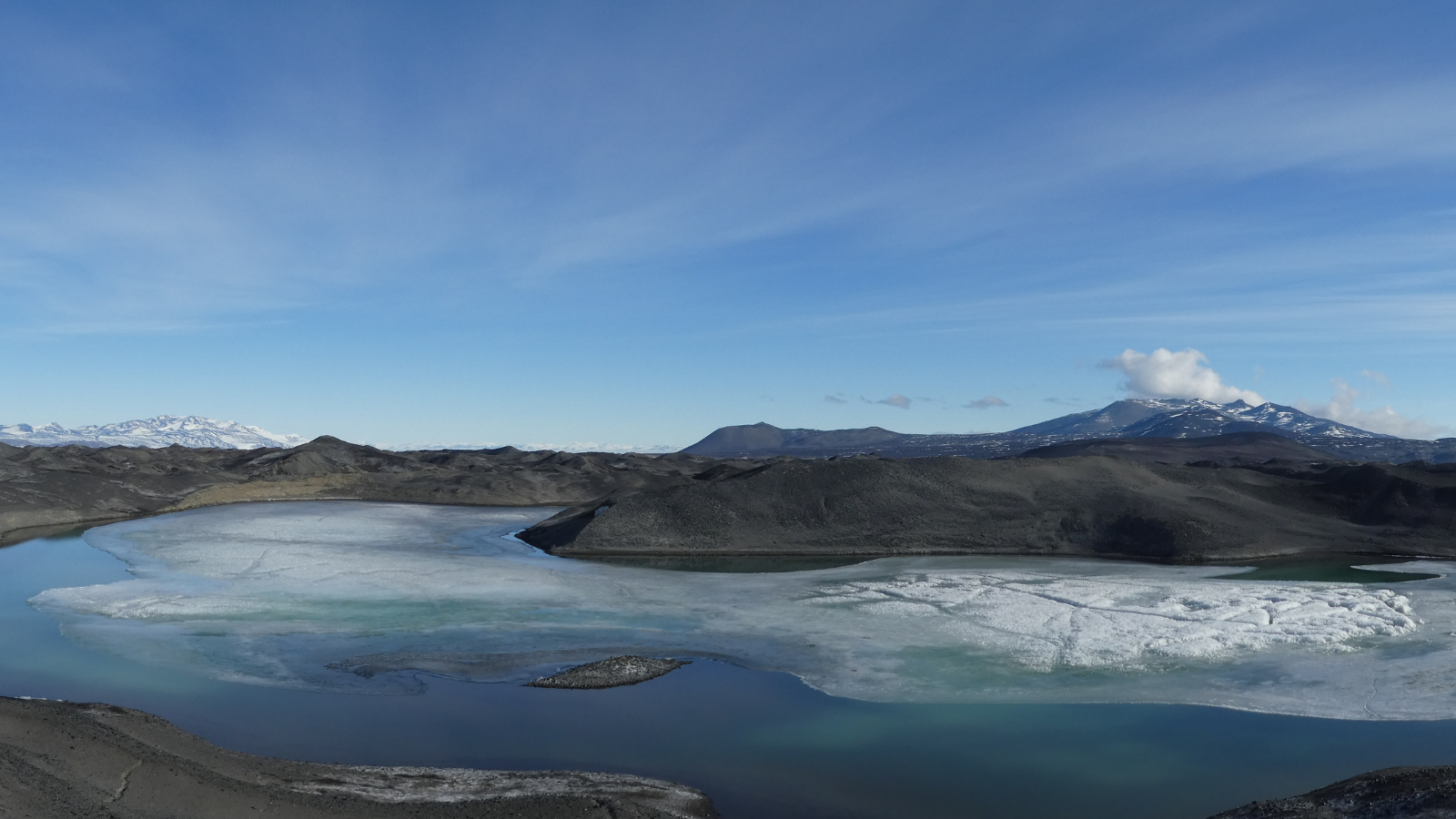
When the planet was locked in ice more than 700 million years ago, small meltwater ponds may have offered refuge to early complex life.
That’s the finding of a new international paper published in Nature Communications, which included research from the University of Waikato’s Dr Ian Hawes, one of New Zealand’s leading polar scientists.
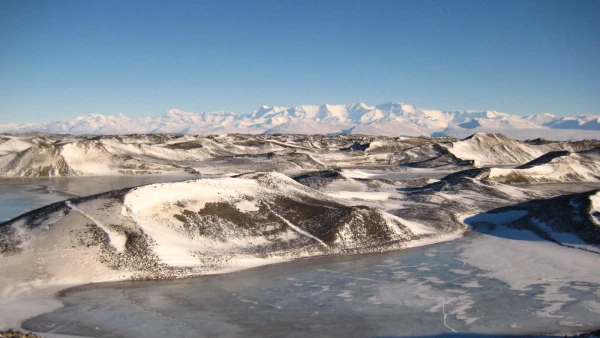
Frozen ponds on Antarctica’s McMurdo Ice Shelf
The team examined modern-day meltwater ponds on Antarctica’s McMurdo Ice Shelf, a region first described by Robert Falcon Scott’s 1903 expedition as the “Dirty Ice.” These ponds form when dark sediment and marine debris rise to the surface of the ice, absorb sunlight and cause small areas of ice to melt.
Each pond contains a self-sustaining ecosystem of simple microscopic life, forming colourful “microbial mats” on the pond floors. These mats are like tiny forests, where photosynthetic bacteria (cyanobacteria or “blue-green algae”) take the roles of trees and provide food and shelter for other simple microorganisms.
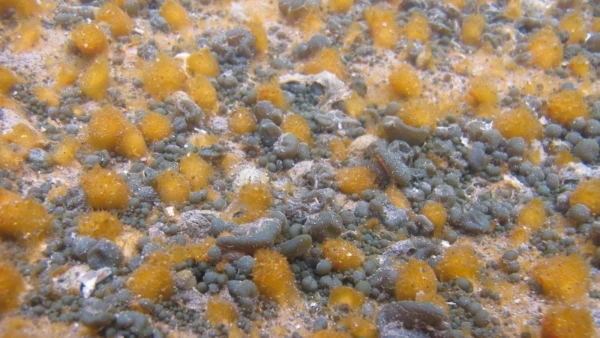
High biomass of cyanobacteria-dominated microbial mat in a meltwater pond
Using genetic fingerprinting and other molecular markers specific to different types of organisms, the researchers found a surprising range of bacteria and microscopic eukaryotes, such as algae, protists, and tiny animals, that together formed simple but intricate food webs. No two ponds hosted the same community, and pond salinity was important in determining who lived where.
The findings support the hypothesis that ponds like these acted as surface refuges during the Cryogenian Period, between 635 and 720 million years ago, when average global temperatures may have dropped to around minus 50 degrees Celsius and the planet iced over (known as a “Snowball Earth”). These results help explain how early complex life could have survived during one of the most extreme chapters in Earth’s history.
As one of the researchers who collected samples in Antarctica and has studied these environments for decades, Dr Hawes says the findings offer powerful insight into how even extreme polar environments can support life.
“One of the reasons why Antarctica is of such value to science is that it gives us windows into how life works in environments unlike the ones that we are used to. The absence of dominance by large, complex organisms allows us to use Antarctic habitats as analogues for how life worked in earlier stages of life on earth – and how organisms survived critical moments.”
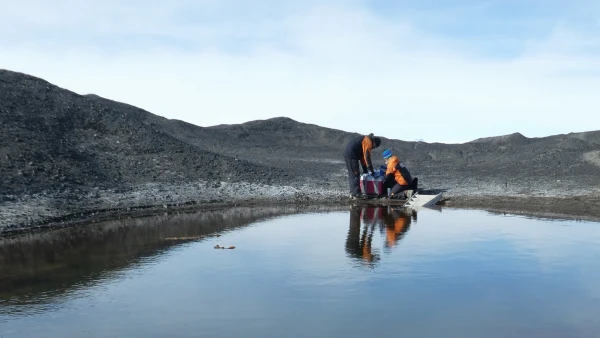
Researchers sampling the meltwater ponds in Antarctica
“We’ve shown that meltwater ponds are valid candidates for where early eukaryotes could have sheltered during these planet-wide glaciation events,” adds lead author Fatima Husain, a graduate student at MIT’s Department of Earth, Atmospheric and Planetary Sciences. “This shows us that diversity is present and possible in these sorts of settings. It’s really a story of life’s resilience.”
The research involved MIT, the University of Waikato, Cardiff University, the Natural History Museum in London and other institutions, with support from NASA and the Simons Foundation.
The paper “Biosignatures of Diverse Eukaryotic Life from a Snowball Earth Analogue Environment in Antarctica” was published in Nature Communications in June 2025.