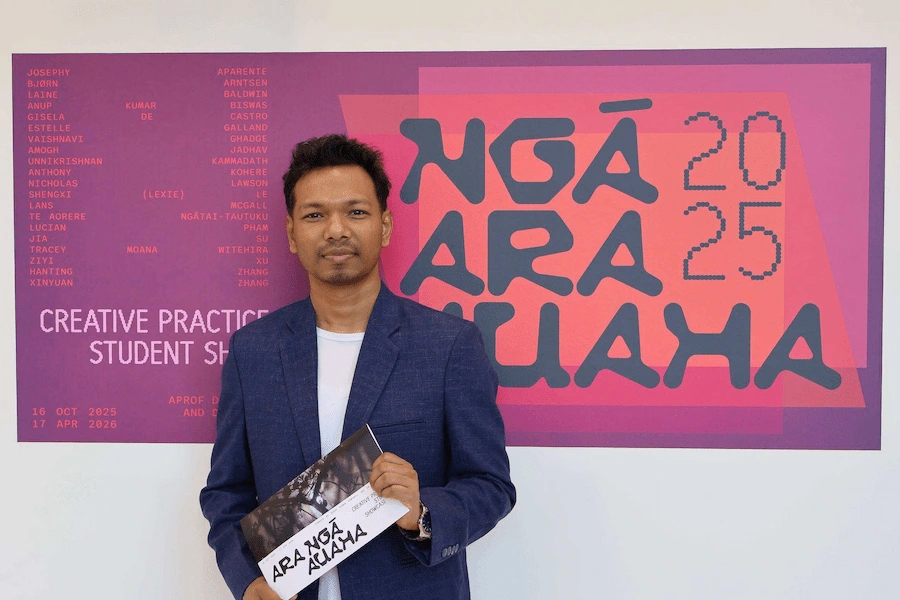

Anup Kumar Biswas
Anup Kumar Biswas turned his media experience into a research-led creative portfolio at Waikato, exploring AI-assisted filmmaking while earning international recognition for his films.
Hamilton

Qualification(s)
Subject(s)
Scholarship(s)
Arriving at the University of Waikato from Bangladesh, Anup Kumar Biswas brought extensive professional experience in media and post-production, along with a desire to explore how emerging technologies, particularly generative AI, are changing filmmaking.
"I wanted to continue building my career in New Zealand in digital media, video production, post-production and AI-assisted filmmaking," Anup says.
"The University of Waikato offered what I was looking for: creative practice, research and emerging technology."
Enrolled in the Master of Media and Creative Technologies in Screen and Media Studies, Anup learnt to turn creative ideas into research-led projects while developing a portfolio of films to support his career.
"My master’s journey changed how I think about creativity and technology. I began by asking what AI could do for filmmaking, but my research led me to deeper questions about authorship, creative labour and human agency.
The films and portfolio I created at Waikato helped me grow from an experienced industry practitioner into a more reflective creative practitioner-researcher, and they now form an important foundation for the next stage of my career.
Graduating with an A grade average across all his papers, Anup says Design and Aesthetics (opens in a new tab) (MEDIA504) broadened his understanding of photography, music, dance, film and aesthetics. It was also where he created a short film, The White Umbrella, which received recognition from nine film festivals.
His Dissertation (opens in a new tab) (MEDIA592) brought everything together. He created a 19-minute AI-assisted animated film, The Broken Rhythm, and wrote an extended exegesis exploring creative labour, authorship and directional agency in AI-assisted filmmaking.
A recipient of the Vice-Chancellor's International Excellence Scholarship, Anup also gained recognition for several films developed during his studies.
"Reflection, created as part of Creative Practice Research (opens in a new tab) (MEDIA508), received three international film festival selections and was selected for the New Order Youth International Film Festival in 2025.
"I was also invited to attend the final awards ceremony and screening of the award-winning films The Capitol Cinema in Auckland."
Reflection was also exhibited at the University's Ngā Ara Auaha 2025, an annual exhibition celebrating student creativity at the Gallagher Academy of Performing Arts.
His other work, Taniwha: The Guardian, was selected for an international film festival and won second place in the Fiction category at FUNFEST 2026 in Portugal.
"These films grew from my academic and creative journey at Waikato and gave me the confidence during my master's to build a portfolio that now supports my professional career."
For Anup, one of the most valuable lessons was that technology does not replace human creativity.
"AI can support and expand the creative process, but meaningful work still depends on human intention, judgement, critical thinking and responsible decision-making."
Qualification(s)
Subject(s)
Scholarship(s)