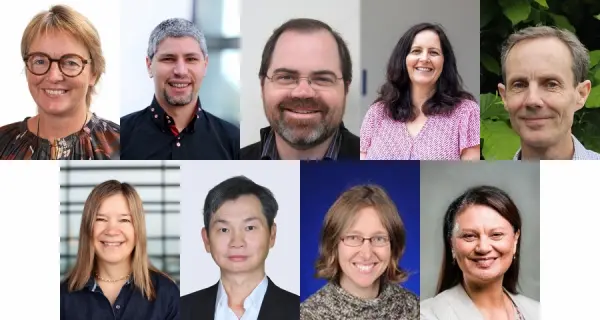
The University of Waikato is celebrating the achievements of 21 academics recognised in the latest round of academic promotions.
Nine academics have been promoted to Professor and 12 to Associate Professor.
Academic promotions recognise outstanding contributions to research, teaching, student supervision and leadership within the University as well as the achievement of an international reputation in each academic’s area of specialisation.
Promotion to Professor
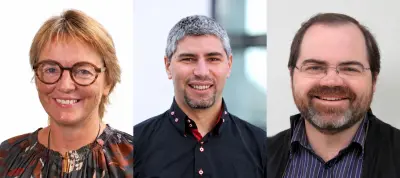
L-R: Professor Polly Atatoa Carr, Professor Leandro Bolzoni, Professor James Carson
Professor Polly Atatoa Carr, Te Ngira Institute for Population Research
Professor Atatoa Carr (opens in a new tab) is a population health scholar whose research and practice look at the broader determinants of population health and wellbeing equity, particularly for tamariki and rangatahi/mapū alongside their whānau and community. She focuses on developing evidence to support health equity and policy translation, and on looking critically at population data. Professor Atatoa Carr combines this work with teaching in population health and health equity, and community governance roles.
Professor Leandro Bolzoni, Te Kura Mata-Ao School of Engineering
Professor Bolzoni (opens in a new tab) works within the Waikato Centre for Advanced Materials and Manufacturing (WaiCAMM) conducting research to gain a fundamental understanding of the physical metallurgy of light metals. The aim is to improve their processing and properties for high-added-value industries like aerospace and biomedical. He also teaches undergraduate and postgraduate courses in materials, manufacturing, and mechanical engineering.
Professor James Carson, Te Kura Mata-Ao School of Engineering
Professor Carson (opens in a new tab) teaches in the University’s chemical and processing and mechanical engineering programmes. His research interests include the measurement and modelling of thermal properties and thermal processes. Currently he serves as leader of Aim 2 of the project Ahuora (opens in a new tab).
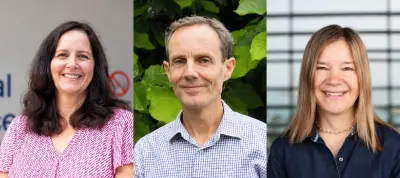
L-R: Professor Lynne Chepulis, Professor Mike Clearwater, Professor Joanne Ellis
Professor Lynne Chepulis, School of Health Equity and Innovation
Professor Chepulis (opens in a new tab) leads several diabetes studies looking into the use of technology and wraparound care for patients, health system factors that can reduce equity in prescribing primary care, and equitable use of funded continuous glucose monitors. She also teaches applied health science and biomedical sciences in the nursing programme.
Professor Mike Clearwater, Te Aka Mātuatua School of Science
Professor Clearwater (opens in a new tab)'s work looks at how plants interact with environments such as forests, wetlands, and managed landscapes. He investigates how plants obtain and use water, cope with environmental stress, and respond to global environmental change.
Professor Joanne Ellis, Te Aka Mātuatua School of Science
Professor Ellis (opens in a new tab) is a marine ecologist and international expert on the effects of multiple stressors on benthic communities. She has led pioneering advances to understand how human drivers of environmental change impact marine ecosystems and translates this knowledge into frameworks that link risks from ecological degradation to social and cultural wellbeing.
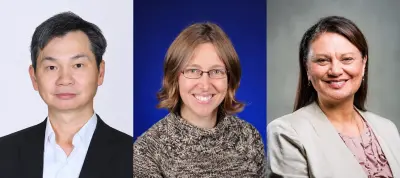
L-R: Professor Leon Li, Professor Julia Mullarney, Professor Linda Te Aho
Professor Leon Li, Te Raupapa Waikato Management School
Professor Li (opens in a new tab)'s research focuses on financial risk management, particularly co-volatility, the corporate bankruptcy domino effect, and volatility of volatility. He is a certified Financial Risk Manager (FRM) through the Global Association of Risk Professionals (GARP). He also teaches finance and sees research and teaching as mutually enriching.
Professor Julia Mullarney, Te Aka Mātuatua School of Science
Professor Mullarney (opens in a new tab) is an oceanographer whose research focuses on ecohydraulics, particularly turbulent flows and sediment transport in vegetated aquatic environments. She has secured Marsden and MBIE funding to investigate and parameterise biophysical processes scaling from fine, localised interactions up to entire estuaries and river reaches. Her overarching aim is to improve predictions of long-term geomorphological evolution and to inform management strategies to enhance the resilience of aquatic systems.
Professor Linda Te Aho, School of Law, Politics and Philosophy
Professor Te Aho (opens in a new tab)'s research and writing weave together mātauranga Māori, legal expertise, and experience in iwi governance. She also teaches on the topics of tikanga, Māori Land Law, and Legal Method and, in 2027, Professor Te Aho will join the Executive Education team teaching the Waikato MBA.
Promotion to Associate Professor
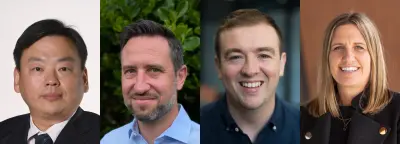
L-R: Dr Martin Bai, Dr Andrew Barnes, Dr Luke Harrington, Dr Joanna Hicks
Dr Martin Bai, Te Raupapa Waikato Management School
Dr Bai (opens in a new tab) conducts research into asset pricing, corporate finance and governance, sustainable/green finance and ESG, FinTech, and educational economics/labour-market mismatch, and has published in ranked finance, accounting, and economics journals. His teaching focuses on undergraduate and postgraduate finance, and he is also the Principal Contact for the CFA Institute University Affiliation Program.
Dr Andrew Barnes, Te Aka Mātuatua School of Science
Dr Barnes (opens in a new tab) researches how biodiversity loss and environmental change can alter the functioning and resilience of ecosystems using field experiments, landscape-scale studies, and global data synthesis. His work has helped establish foundational principles linking food webs, biodiversity, and ecosystem functioning, informing biodiversity conservation and restoration in New Zealand and internationally.
Dr Luke Harrington, Te Aka Mātuatua School of Science
Dr Luke Harrington (opens in a new tab) is a physical climate scientist and leads the Climate Extremes and Societal Impacts (CLESI) research group. His team investigates how a warming world influences extreme weather both in Aotearoa and globally. He engages extensively with the media and decision makers about the ongoing impacts of climate change, while also teaching several undergraduate papers within the University’s Bachelor of Climate Change degree.
Dr Joanna Hicks, School of Pharmacy and Biomedical Sciences
Dr Hicks (opens in a new tab) researches host-pathogen interactions to understand bacterial pathogenesis, immune evasion, and antimicrobial resistance. She teaches biomedical science with an emphasis on developing engaging, research-informed learning experiences that encourage students to think critically.
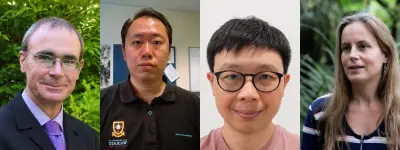
L-R: Dr William Jennings, Dr Ye Chow Kuang, Dr Hin Lim, Dr Ang McGaughran
Dr William Jennings, Te Kura Toi School of Arts
Dr Jennings (opens in a new tab)' research focuses on French colonial expansion in the seventeenth-century Americas and in nineteenth-century New Zealand and the Pacific. He examines relationships between French settlers and other communities to understand the social context in which new languages and cultures emerged.
Dr Ye Chow Kuang, Te Kura Mata-Ao School of Engineering
Dr Kuang's research focuses on applied signal processing, machine learning, and algorithm optimisation to address complex engineering, scientific, and industrial challenges. He also teaches electrical and electronics engineering with the aim of giving students a comprehensive foundation in the discipline.
Dr Hin Lim, Te Kura Mata-Ao School of Engineering
Dr Lim (opens in a new tab) leads the Mechatronics Engineering programme, which recently gained full Washington Accord accreditation. His applied agricultural robotics research has produced robotics platforms that he has successfully field-trialled in orchards and vineyards.
Dr Ang McGaughran, Te Aka Mātuatua School of Science
Dr McGaughran (opens in a new tab) uses genomic, ecological, and environmental DNA approaches to understand and manage invasive species. Her research helps to uncover the drivers of invasion success and to determine invasive species' origins, movements, and evolutionary histories, providing insights that support biosecurity and environmental wellbeing.
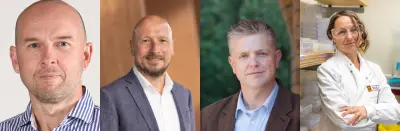
L-R: Dr Oleg Medvedev, Dr Will Roberts, Dr Joseph Ulatowski, Dr Adele Williamson
Dr Oleg Medvedev, School of Psychological and Social Sciences
Dr Oleg Medvedev (opens in a new tab)‘s research combines health and developmental psychology, psychometrics, and data science to investigate the protective and risk factors that shape physical and mental health. His work uses advanced measurement methods and AI to support the prevention of stroke, dementia, and mental-health decline. He teaches health psychology and research methods, and is also Editor-in-Chief of the journals Mindfulness and Journal of Psychology and AI.
Dr Will Roberts, School of Sport and Human Movement
Dr Roberts (opens in a new tab)' teaching and research focus on sport coaching, skill acquisition, and athlete development, with particular emphasis on person-centred approaches to learning and performance. He has led national and international projects exploring children’s rights, play, and participation in sport, and worked with elite sporting organisations and government agencies to develop and embed person-centred coaching practices.
Dr Joseph Ulatowski, School of Law, Politics and Philosophy
Dr Ulatowski (opens in a new tab) researches the philosophy of language, experimental philosophy, and the history of the Lviv-Warsaw School of Philosophy. He specialises in the nature and value of truth, and collaborates extensively on projects exploring truth, action individuation, self-narratives, and applied ethical issues in security and research ethics.
Dr Adele Williamson, Te Aka Mātuatua School of Science
Dr Williamson (opens in a new tab) is a biochemist who studies the enzymes that cells use to repair and replicate DNA. Her research helps to understand how microbes can survive extreme environments, provides potential antibiotic targets and new molecular tools for biotechnology.