Dr Luke Harrington has been recognised with a prestigious Prime Minister’s Science Prize for his outstanding contributions to climate change research.
He is this year’s recipient of the Prime Minister’s MacDiarmid Emerging Scientist Prize, awarded by Royal Society Te Apārangi to acknowledge and support an emerging scientist who has demonstrated research excellence and made a significant contribution to their scientific field.
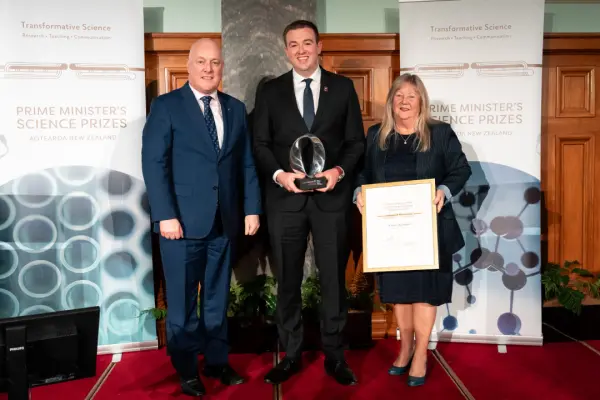
Prime Minister Christopher Luxon, Dr Luke Harrington, Minister Penny Simmonds
For this award, an "emerging scientist" is defined as someone within eight years of the conferral of their PhD.
As leader of University of Waikato’s Climate Extremes and Societal Impacts research group, Dr Harrington (opens in a new tab) has developed methods to quantify how climate change is influencing the frequency and intensity of extreme weather events not just in New Zealand but globally.
His research is helping communities, policymakers, and decision-makers better understand the role climate change plays in shaping extreme weather and its impacts on society.
A desire to understand the science behind a changing climate inspired Dr Harrington’s research career. The Senior Lecturer in Climate Science has been at Waikato for the past four years, where he’s enjoyed the freedom to explore important climate questions and develop research with real-world impact.
“The University of Waikato offers a lot of trust and freedom to just get on with the research we think is most interesting. And as my research team has grown, so too has the support of the University, which is fantastic," he says.
Climate change piqued his interest because it drew on all his favourite subjects.
“To understand how the climate system works as a whole, you actually need elements of physics, chemistry, biology, maths and geography as well.”
While sea-level rise and extreme rainfall are often seen as New Zealand’s primary climate change risks, there are other hazards Dr Harrington’s team have been investigating including drought and extreme heat, neither of which are generally at the front of New Zealanders’ minds.
“Almost everyone has woken up to the risks we face from a rapidly warming climate. Yet, we still mostly think about extreme weather events only after they've happened rather than systematically planning ahead. Our research focuses on quantifying the specifics of what the most impactful heatwave, drought or flooding events might look like over different regions in the future. We also work to understand whether and how past experiences of extreme weather can skew our expectations of what might come next.”
Dr Harrington sees the award as recognition of both his work and the contributions of the colleagues who have supported his research journey.
“Climate science requires a lot of collaboration, both here in New Zealand but also globally. Hence, I think any recognition of my research is more a reflection of the efforts put in by students and colleagues that I'm fortunate to work with every day.”
Dr Harrington is currently leading three major research programmes focused on understanding how extreme weather events are changing in a warming climate.
The Marsden Standard Grant project Could land aridification supercharge summertime warming rates in a maritime climate like Aotearoa? investigates why some parts of New Zealand are warming faster than expected during summer, despite being surrounded by oceans, and aims to better predict how hot and dry New Zealand summers could become in the future.
The Natural Hazards Commission Toka Tū Ake University Research Programme, How misleading are past experiences when planning for future record-shattering rainfall extremes?, will help identify which parts of New Zealand could face unprecedented rainfall in the coming decades and how communities can prepare for these events.

Dr Harrington’s work has been widely recognised over the years.
The MBIE Smart Ideas project, Physically plausible record-shattering drought events in a warming Aotearoa explores the potential risks associated with unprecedented future droughts which would be a crucial step towards ensuring New Zealand’s economy remains resilient to a rapidly warming climate.
He won the Early Career Academic Excellence award at the University of Waikato Staff Awards in 2024. In 2023, he also received the New Zealand Meteorological Society’s prestigious Edward Kidson Medal.
In 2025 he was one of only two New Zealanders appointed as a Working Group 1 Lead Author for the Intergovernmental Panel on Climate Change's (IPCC's) Seventh Assessment Report, which sees him assessing and bringing together information about future regional changes in climate extremes worldwide.
He works alongside 192 other experts from 62 countries; each selected from a pool of nominations from governments and IPCC observer organisations based on their expertise.
Deputy Vice-Chancellor Research Professor Gary Wilson (opens in a new tab) says Dr Harrington’s recognition reflects both the quality and impact of his research.
“Luke has established himself as a highly regarded scientist in the climate change arena. The University is proud of the contribution his research is making not only on a New Zealand level, but internationally as well.
“It is a great example of our research having wide impact and helping wider New Zealand address some of it most challenging environmental problems.”
The Prime Minister’s MacDiarmid Emerging Scientist Prize is one of five awarded every year and is worth $200,000.