Dr Rachel Tan
Being pelted with rubbish and told to “go back to where you came from” while filling up her car at a petrol station is what drove University of Waikato law lecturer Dr Rachel Tan to research online hate and discrimination.
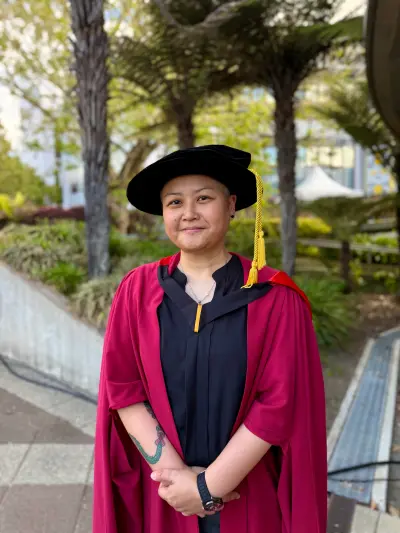
Dr Tan (opens in a new tab), a lecturer at the University’s Tauranga campus, received her PhD at last week's graduation ceremony for her research examining how hate speech on social media should be regulated in New Zealand, and whether existing laws go far enough to protect people from online harm while preserving freedom of expression.
With debate continuing over restricting social media access for under-16s, her research raises important questions about the responsibilities of social media companies and whether stronger regulation is needed to create safer online environments.
"I’ve always had a desire to live in a more inclusive society,” Dr Tan says.
“I’ve been the target of racial abuse countless times over the years. On one occasion, while I was filling up my car at a petrol station in Australia, a car drove by, skidded to a stop right in front of me and threw a brown paper bag at me while screaming ‘go back to where you came from’.
“What really shocked me was that everyone else completely ignored what had happened.”
Born in Malaysia, Dr Tan studied in the United Kingdom and Australia before moving to New Zealand in 2018 to pursue postgraduate study at Waikato. The Christchurch mosque attacks that followed cemented her decision to investigate hate speech through a legal lens.
New Zealand has several laws addressing harmful online behaviour, but Dr Tan says the current framework is fragmented and largely reactive, responding to harm after it occurs rather than requiring social media companies to prevent it.
Social media companies have community guidelines, but their enforcement can be inconsistent. Legal obligations need to extend to the platforms themselves.”
Rather than simply introducing tougher hate speech laws, Dr Tan argues that New Zealand needs to shift its focus towards requiring social media platforms to identify and reduce risks before harm occurs.
“Platform algorithms and design also contribute to the spread of harmful material. One of the biggest challenges is balancing effective risk mitigation with strong protection of freedom of expression, while avoiding excessive content removal.”
Dr Tan says restricting social media access for under-16s could help address some online harms, but a ban alone is not the answer.
“Governments need to examine the underlying systems that allow online harm to spread."
Drawing on regulatory approaches in Australia, the United Kingdom and Europe, her research proposes introducing a statutory duty of care, which would legally require social media platforms to assess and manage risks associated with their services.
It also recommends greater transparency around algorithms and independent regulatory oversight, rather than leaving responsibility for online safety solely with individual users.
We need platforms to take greater responsibility for the products they've created and made accessible to people of all ages.
“New Zealand can learn from international approaches, including Australia’s eSafety Commissioner, and consider an independent regulator to oversee online safety, platform accountability and risk management.”
After completing her Master of Law at Waikato and while in the early stages of her PhD, Dr Tan was diagnosed with breast cancer in 2019, forcing her to put her studies on hold while she underwent surgery, chemotherapy and radiation therapy.
She attempted to continue writing during treatment but struggled with chemotherapy-related cognitive difficulties, known as ‘chemo fog’.
“It was such a dark time. I wasn't even fully confirmed for my PhD yet, and I kept thinking, ‘what do I do?’ Thankfully, the faculty was incredibly supportive throughout.
“Several months before submitting my thesis, I had to revisit the first few chapters I'd written. I remember looking at them and thinking, ‘Who wrote that? What was I trying to say?’”
With treatment completed – and further delays with Covid-19 – Dr Tan eventually continued her PhD part-time while building her academic career as a tutor.
Dr Tan hopes her research will contribute to conversations about how New Zealand can better protect people from online harm while safeguarding freedom of expression.