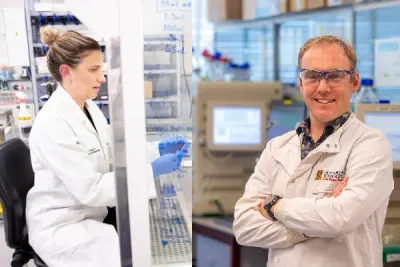
Lead researchers, Dr Joanna Hicks and Dr William Kelton
University of Waikato researchers are laying the groundwork for a rapid gonorrhoea test that could make testing faster, more affordable and accessible to communities across New Zealand and the globe.
The project, led by University of Waikato biomedical scientist Dr Joanna Hicks (opens in a new tab) and Dr William Kelton (opens in a new tab) and has received $300,000 in funding through Infectious Diseases Research Aotearoa's first funding round.
The research aims to develop the scientific foundations for a low-cost test that works in a similar way to a rapid Covid-19 test, capable of quickly detecting gonorrhoea in people with and without symptoms. The technology could help reduce delays in diagnosis and treatment, improve access to care and support more targeted antibiotic use.
Working alongside University of Waikato researchers Dr Adele Williamson, (opens in a new tab) and Massey University's Dr Collette Bromhead, the team will investigate the potential of nanobodies – small, stable antibody fragments – to detect the bacterium responsible for gonorrhoea.
Dr Hicks says the goal is to pave the way for a rapid test that could eventually be used in sexual health clinics, primary care and community settings, without relying on central laboratory testing.
"Gonorrhoea is one of the most common sexually transmitted infections worldwide, but many people experience few or no symptoms, meaning infections can go undetected and untreated," Dr Hicks says.
"Untreated gonorrhoea can cause serious health complications, including infertility, and contribute to the ongoing spread of infection.
Improving access to fast, accurate testing could make a real difference, particularly for communities that face greater barriers to healthcare access.
The research will focus on nanobodies that recognise specific structures on the surface of Neisseria gonorrhoeae, the bacterium that causes gonorrhoea.
Researchers will assess how effectively and accurately these nanobodies bind to the bacterium, their stability under different conditions and their potential for use in a future rapid testing device.
The technology could also help address growing concerns about antimicrobial resistance by enabling faster and more accurate diagnosis and supporting more appropriate use of antibiotics.
The project is among the first to receive funding from Infectious Diseases Research Aotearoa, a Government-funded national research platform established to strengthen the New Zealand's ability to respond to ongoing infectious disease challenges and future pandemic threats.
Other funded projects will explore improved treatments for patients hospitalised with severe influenza, ways to reduce antimicrobial resistance in primary care, and better monitoring of respiratory viruses circulating in the community.
Infectious Diseases Research Aotearoa Director Steve Barnes says the first funding round is an important step towards turning national research investment into practical outcomes for New Zealanders.
“These projects demonstrate how research can deliver practical benefits for New Zealanders. They support research that reflects real-world needs, such as the evidence health professionals require in their daily work, and new knowledge to improve outcomes for communities dealing with common and persistent diseases," Mr Barnes says.
"Each project has the potential to reduce harm and strengthen New Zealanders against infectious diseases."